How to Be People of Influence and Purpose

Do you want to live a life of influence and purpose? Jesus wants that for you too.
Jesus wants you to live a life of influence and purpose by learning to pray, to talk and to listen.

One of the issues that comes up most often in my pastoral work, particularly as I and my peers hit middle-age, is how we can live a life of influence and purpose.

I think a lot of us crave both of those things. We want to know what we are doing with our lives and to feel it is worth it.

I’ve noticed that this sense is even stronger among the young people I meet. They struggle with the pressure (and desire) to change the world, but simultaneously with the knowledge that doing so seems next to impossible.

I have often wondered to myself if this is a major contributor to the epidemic of anxiety and self-harm that is well documented among under-20s. They know they want to do something about a world they are repeatedly told is dying (and have a moral obligation to do so) but practical forms of action that make a real difference are not available to them. The result is familiar to anyone with a passing knowledge of religion and history: a sense of guilt accompanied by helplessness that generates anger and anxiousness. The guilt cannot be forgiven because there is noone to absolve, and the helplessness cannot be overcome because there is nothing an individual can do to atone for a shared sense of failure (that the planet is burning or some such) or to repent by putting the wrong right.

I was meditating on some of these concerns as I read Mark 1:20-39.

Before I explain what I think this passage has to say about this in any more detail, I what I’m going to say in one or two sentences so it is easy to remember. Here is today’s:

Jesus wants you to live a life of influence and purpose by learning to pray, to talk and to listen.

Before you go any further, you should read the passage using the link above. What I’m saying will make more sense if you know what I’m talking about.

  1. Let Jesus Influence You By Learning to Pray

The first thing we see in this passage is that when we choose to bring Jesus into our lives he can bring real and positive change.

The scene is set in Capernaum, a town in Northern Israel where Jesus was based. He and his students had been in the synagogue, worshipping and Jesus had delivered a man who was afflicted with an evil Spirit. You can read about it in the previous couple of paragraphs.

Now they go back from the synagogue to Simon and Andrew’s house. 

Notice that they don’t go there because Simon’s mother-in-law is sick; Simon doesn’t tell Jesus about it until he’s already at the house. They go because Jesus’ students are making Jesus a part of their whole lives. He isn’t just someone they listen to in the Synagogue and then try to remember what he said, or marvel at what he did. Those are good things. But the disciples do something more. They take Jesus home with them.

The benefits of making Jesus a part of our whole lives become obvious when we look at verse 31. Because Jesus is with them outside the Synagogue, they are able to ask him for what they need when they need it. So they arrive home and Simon’s mother-in-law is sick, very sick. And because Jesus is there, Simon is able to ask him to help.

It’s a process. First you accept you need Jesus outside church. You start to read your Bible (or a Bible app) and to worship at home during the week, build a devotional life, begin to pray about work, or family, or your day. Then when a crisis starts to emerge – your family are sick or you need help – you know who to ask and know he is there.

It is then that Jesus heals her. He responds to Simon’s request, in effect to Simon’s prayer. 

This is a pattern that occurs again and again throughout the Scriptures. Jesus doesn’t impose himself on people (unless they are completely bound by demons or sickness). He allows us to choose the extent to which we will accept his presence in our lives.

You might be thinking: “That’s fine for Simon. He had Jesus there with him. I’d invite Jesus around for lunch if he were here.”

That’s a completely understandable response. But I do have a couple of observations.

First I’d gently push back and say: would you? 

Lots of people didn’t. How can you be so sure? How can I? I know I make a lot of excuses for why I don’t cultivate my spiritual life – why I don’t pray and read the Bible that range from the good (I’ve been called to rush to hospital) to the bad (Spurs might score and I don’t want to miss it).

But more importantly, second: we can be with Jesus in all of our life, not just in church. 

Christ isn’t still here bodily. It’s better than that. That is the reason for his Ascension into heaven and the sending of the Holy Spirit. In Simon’s day, only one person’s house could have Christ in it. Now he can be with you wherever. 

That’s the starting point for everything. A great preacher once said that, “Jesus’ power is in his presence”. If you want to be someone of peace, purpose, and influence the most important thing is to be someone whose life is full of Jesus – not just someone who comes to church on a Sunday morning.

He’s what you ultimately need.

  1. Influence Others By Learning to Talk

The next thing I notice in these verses is that word spread.

We’re not told how, but at some point during that afternoon the word about what Jesus had done for Peter’s mother-in-law spread all around the village. 

Capernaum wasn’t a huge place. Even so, this is very impressive. In a matter of hours word has spread and there are queues of people outside waiting for Jesus.

What have they come for? For an evangelist or preacher it is tempting to want to see this as a revival – of people desperate to receive forgiveness or to hear Jesus preach.

That isn’t what Mark says, however. It’s much more relatable than that. 

Look at verse 33. The crowds come to ask Jesus to do for them what he had done for the man in the Synagogue and for Peter’s mother-in-law.

What has happened is that the man who was set free – who experienced mental and spiritual healing – and those who had been blessed by the physical healing have gone around and told people. 

They haven’t tried to tell everyone who Jesus is. As far as we know, they haven’t given them a tract or called them to repent (there’s certainly no evidence of that here).  They have just told their stories of how Jesus has helped them, of how they have benefited from his presence. And others have decided that they want some of that too.

Again, this is a pattern we see repeated over and over again. Heather touched on it a couple of weeks ago in her talk about how Philip and Nathaniel came to follow Jesus. 

One of the main ways, if not the main way, that ordinary people brought others to know Jesus in the New Testament was to learn to talk about how they had benefited from him, what he had done from them. Then others think they want a piece of that.

Again, we’re going to look at the practical way to do this more in a moment. 

Fundamentally, however, it relies on two basic ideas that I think most people who know Jesus would agree with but that we sometimes forget.

  1. Knowing Jesus is good for us – we get loads from it.
  2. Knowing Jesus would really help others – they would get loads from it.

If you agree with both of those ideas then it makes sense that we would want to talk about our own experiences of Jesus or church with others. I get this is difficult so I’m going to explain how to do it better in a moment (not that I’ve particularly nailed this, but I am learning!)

  1. Find Purpose By Learning to Listen

So I have argued for making Jesus a part of our whole lives – at work, at football, at school, at a care home, even at church. And that when we do, we should then want to share that with others.

But what about direction? This is one of the biggest felt needs I come across pastorally. And I don’t have a magic bullet. 

There isn’t a way to buy a cheat-map of life with all the right answers on it. And for good reason. 

A life of faith is a life that is necessarily built on trust. It isn’t about me knowing all the answers and then being able to implement them. It is more about me entrusting myself to someone else to lead me and guide me.

In that sense it’s more like rally-driving than it is Formula 1. 

In Formula 1, everyone knows the track – it’s easy. The question is how well can you navigate it as fast as you can. In rally driving the track is varied and variable. You’re driving but it is the navigator who knows where you’re going. The driver needs him and has to trust him.

A life of faith is like a rally-race.

But that doesn’t mean we’re helpless. What we see when we look at Jesus’s example in verse 35-39 is that, while we may not know every turn we should take in advance, we can know the principles that help us to make good choices. We can know why we are here, what we should prioritise, and when we need to be alert to dangers.

That kind of sense of purpose comes from spending time in quiet prayer with God. It might be sitting silently in a chair. It might be going for a long walk. It might be something completely different. But it is about learning to quiet every other voice, to present ourselves to God and then to say what do you want? What do you want for me?

When we do that regularly, we don’t get all the answers to every choice we should make. But we become aware of the values and principles that should guide us – why we have come, to paraphrase Jesus’ words.

It might be saying yes to a promotion because it allows you to provide for more people or lead in a way that will bless them. Or “no” to a promotion because God has called you to be a father or mother first.

It might be saying no to an opportunity because you know it will distract you from something else or to go and try something new because you want to meet new people to speak to about Jesus.

I can’t answer that question because I’m not you. 

But the only way to get peace and stop being restless is to ask, to make time to listen to the answer and then act on it.

Jesus wants you to live a life of influence and direction by learning to pray, share and listen.

Application

What does this mean for us as we try to know hope, show hope and share hope.

Choosing to make Jesus a part of our life isn’t harder now than it was then, it’s easier. This is a quick set of suggestions for how to do it. You can add to them or take them away as you wish. I’ll start at the beginning of the day.

  • Set up part of your house as a prayer area. That’s where you’re going to go to pray or meditate in the morning and evening. You might designate it with an icon or a cross or something.
  • When you wake up in the morning, pray. The amount you can pray is going to change depending on your circumstances. But everyone here can pray first thing. Everyone here has some time.
    You can make up your own prayers – using T.A.P. That takes about 4 minutes.
    You could use a prayer book or app – I’m happy to recommend them.
    But pray. First thing. Before checking Facebook.
  • Take on Scripture. You can do this by reading it, listening to it, or meditating on it. Again, everyone can do this. You can listen to a 10 minute podcast while you breastfeed or a 15 minute devotional while you drive to work. Or if you have more time, you can spend an hour in silent meditation.
    But do something. You probably won’t feel an immediate benefit but over time it will help immeasurably.
  • Pray before meals and before work. This sounds as simple as it is. Say thank you for your food 3 times a day. Before you start work or a task, thank God for it and ask for his help.
    This starts to build an awareness that Jesus is at work in these places and changes our attitude.
  • At the end of the day, before bed, spend 5 minutes remembering the day. Then say thank you for anything you are grateful for and sorry for anything you regret. I find it helps to journal this 
  • Find times when you can be away from others and quiet. Take headphones out or off. If there are decisions that have to be made, ask God about them and then walk or sit in silence. For at least 30 minutes.

Jesus wants you to live a life of influence and purpose by learning to pray, to talk and to listen.

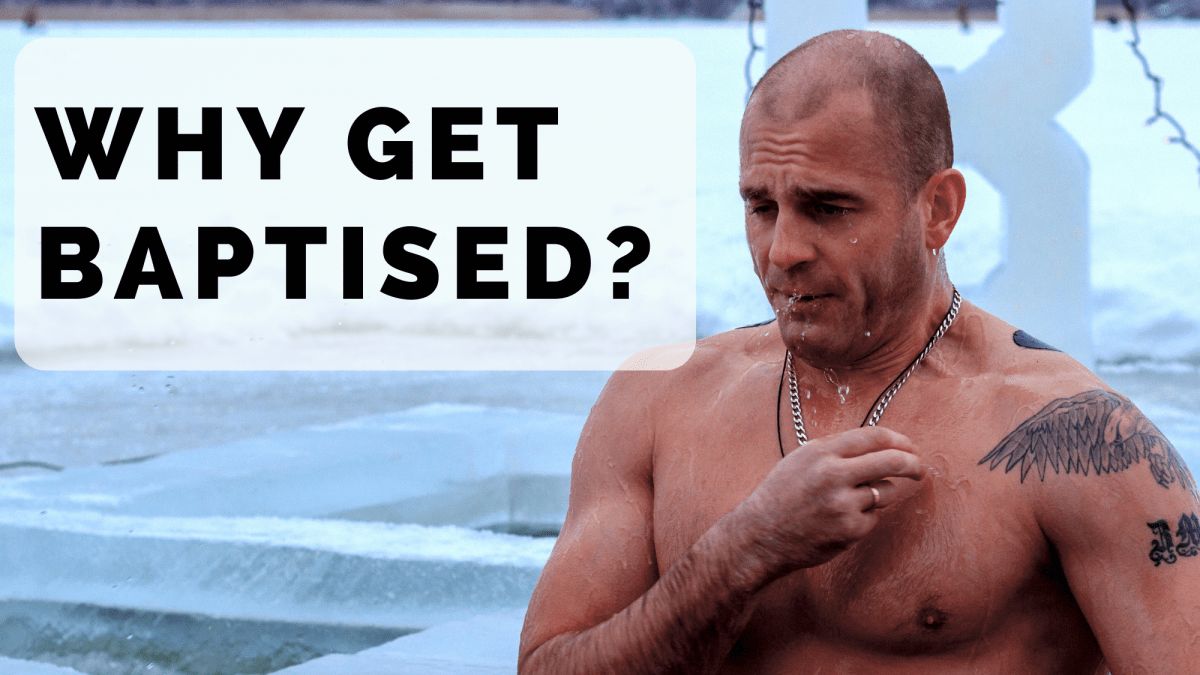
Why Get Baptised?

Why get baptised?
Jesus died because he loves me and gives me new life. Baptism is how I receive that gift.

Then Peter stood up with the Eleven, raised his voice and addressed the crowd: “Fellow Jews and all of you who live in Jerusalem, let me explain this to you; listen carefully to what I say…

“Therefore let all Israel be assured of this: God has made this Jesus, whom you crucified, both Lord and Messiah.”

When the people heard this, they were cut to the heart and said to Peter and the other apostles, “Brothers, what shall we do?”

Peter replied, “Repent and be baptized, every one of you, in the name of Jesus Christ for the forgiveness of your sins. And you will receive the gift of the Holy Spirit. (Acts 2:14, 36-38)

Introduction

The gospel is amazing news. Jesus died because he loves me and offers me new life.

Think about that for a moment.

The Son of God loved us, saw us in our sin, guilt and shame, came to live with us as one of us, took the punishment, the stain, the poison of sin, and then buried it in the ground. He releases us, cleans us, changes us, forgives us, and defeats the Devil for us.

Basically it’s brilliant.

But why do Christians get baptised in response to it?

After all, it is on any view a strange sight. An otherwise sane boy or girl, man or woman stands in a massive bath, fully dressed (thankfully), and then allows a pastor or leader to dunk them under the water. They emerge, drenched, for a room full of Christians who are clapping, cheering and (occasionally) crying.

Ancient Roots

It’s weird, properly weird. But it is also ancient.

It is the earliest recorded teaching of the Christian church that we receive new life by believing that Jesus rose from the dead, acknowledging that we need his love and forgiveness, committing ourselves to follow his teaching and being baptized into his church. Everyone who wants to follow Jesus is commanded by the apostles and their successors to be baptized.

We could give loads of examples from the New Testament. Here are just a few:

  • Jesus got baptized (Matthew 3:13-16; Mark 1:9-11; Luke 3:21-22).
  • Jesus’s followers then baptized new believers while Jesus was alive (John 3:22).
  • Jesus told his followers to go and baptize people all over the world (Matthew 28:19-20).
  • When the first church began at Pentecost, Peter commands new believers to be baptized (Acts 2:38-39).
  • That pattern is replicated over and over throughout the early churches – people hear, they believe in Jesus, they trust him, and they get baptized (Acts 8:34-40, 9:17-19 etc).

These are just a few references that you can look up to see the way baptism is a central part of the start of a Christian journey. That pattern carried on after the New Testament. Everywhere people became Christians, they got baptized.

But Why?

There is an enormous amount that could be written about baptism. At its heart, though, baptism has both a spiritual and practical effect in our lives as Christians.

Spiritual Effects

We believe that baptism is about what God has done and is doing in us through Jesus Christ.

When we are baptized we receive God’s grace and are united to Jesus and to the church.

Two pictures help us understand this: burial and bath-time.

When we go under the water we are identifying with Jesus dying and being buried. That is what St Paul means when he says “we are buried with him through baptism”. Then when we come up out of the water we are identifying with Jesus rising from the dead.

It is as if we are looking at what Jesus has done for us and saying ‘yes, I want to be a part of that’ and in response God says ‘OK, then I’ll make you a part of that’.

This isn’t just a sign or an act; it really changes us in our spirits. When we are baptized, we receive God’s grace and are united to Jesus and to the church. 

This brings me to the second picture: a bath.

I love to play football. When I do I end up covered in dirt and sweat and (sometimes) blood.

I come in from a game and before I can get on with the rest of my life, I need a bath or a shower. I need to soak in the clean water to get all of this grime and grease and stain off me. Then I can start afresh.

Part of the symbolism of baptism is that of a bath, of washing. I don’t mean that we clean our bodies. It’s about a deep cleansing for our souls.

Baptism, as a part of the whole process of identifying with and trusting in Jesus, is how God washes us clean of all the dirt and grime of sin – of the human propensity to mess stuff up, the unkind words, acts of temper, moments of violence and bitterness, the selfishness or snideness, the dishonesty or disrespect – that cling to us through our lives.

Practical Benefits

But there is a practical benefit too.

Following Jesus can be a life of great joy and peace and purpose. It is to live in tune with the moral and spiritual music of the universe, to find community and comfort and peace.

But it can also be really hard. There are times when we mess up, times when others hurt us, times when we are rejected or bereaved, times when we doubt God’s love for us, our faithfulness to him, or even his existence.

When we go through these experiences, God has given us something concrete to cling to.

Whenever you feel like this, you can look back to today and remember the feeling of being wet. You can remember the way the water touched every part of you. That was real, it was tangible. And it is a promise; that God will never leave you or forsake you, that, in the words of St Paul,

neither death nor life, neither angels nor demons, neither the present nor the future, nor any powers, neither height nor depth, nor anything else in all creation, will be able to separate us from the love of God that is in Christ Jesus our Lord.[1]

So What?

What does this actually mean for us?

Some of us may never have actually responded to what Jesus did for ourselves.
Jesus lived, and died and rose again for all of us. But we have to accept it and make it our own. It’s a bit like being given a cheque for a huge amount of money. It doesn’t benefit me unless I cash it.  You might have been in church your whole life or this might be your first time. If you’ve never consciously responded then take a moment to do so even as you read this.

Others might have become followers of Jesus recently or in the distant past. But maybe you haven’t yet been baptised. If that’s you, I want to encourage you to get baptised. It is commanded by Jesus, it is good for you now, and it will help you in the future.

Jesus died because he loves me and offers me new life.Baptism is how I receive that gift.


[1] Romans 8:38-9

Theology, Wisdom and the Fear of God

Theological writing and debate (let alone preaching) would be immeasurably improved if everyone involved imagined they will have to read out every word we write or say in public, in the presence of Christ and all the saints. 

The badge of my present University includes a Latin motto. I must confess that I had seen it lots of times but never really noticed it until last year. It reads: Initium Sapientiae Timor Domini, the Fear of the Lord is the Beginning of Wisdom. 

It is a quote from Scripture. In Psalm 111:10 we read that:

“The fear of the LORD is the beginning of wisdom;
all those who practise it have a good understanding.
His praise endures forever!”

In other words, you cannot even begin to be wise until you have learned the fear of the Lord. Wisdom depends upon a sense of reverence for God, of respect, of the genuine fear that comes from knowing that someone else is immeasurably more powerful, wise, good and authoritative than you are. 

It is a sentiment that I recognise from my time in court, particularly in the higher courts. Only a fool went into the Court of Appeal (or, I am sure, even more so the Supreme Court) without a healthy fear of the venerable, esteemed, brilliant and ruthless minds one was going to find there. The beginning of making good and wise submissions, of success, was to revere and respect the judges.

I wonder what it would mean for that sentiment to be taken seriously in contemporary theological discussion, writing and debate. 

As I have attended conferences, read papers and responded to them over the last few years I have been first struck, and then alarmed, by the lack of fear of God that accompanies a lot of Western theology. Theological work ought to be characterised by respect for God, by a sense that it really matters and will be judged. It should be underpinned by the knowledge that whatever we say (and of course it will be inadequate), we are seeking to speak of, and on behalf of, the Supreme Judge of the Universe.

This doesn’t mean that we shouldn’t take risks or be willing to disagree and dispute, and think creatively. But our discourse should reflect the fact that how we speak of God matters and that it matters primarily not because it impacts on other people but because God himself matters most of all.

Too much theological work in the West is flimsy. It lacks moral and intellectual seriousness, sometimes shown by a lack of rigour or work. It is willing to speak about God in ways that do not treat him seriously and show a lack of respect for his people, his church and those who have gone before us. 

A Couple of Examples

I think, for example, of a paper I heard presented recently. The burden of the paper, explicitly, was that St Paul was a misogynist. It is an interesting contention, and one that should not be made lightly since it involves an attack on the moral and intellectual character of one of the leading Christian thinkers in history and a man venerated as a servant of God in every part of the church. It also involves impugning the moral credibility and reliability of Paul’s writings, particularly in the New Testament.

These would be big charges to bring against anyone, let alone someone of the intellectual and spiritual stature of Paul. Yet the paper tried to argue for Paul’s misogyny on the basis of a single passage (1 Corinthians 15 in case you’re interested), extracted from its context, without addressing (or even, I checked in questions, considering) the intention of that passage or alternative interpretations of it. The paper didn’t even address or reflect upon what Paul said in the rest of that letter.

There are interesting questions about how Paul deals with men and women, and particularly how we apply that in the contemporary church. But the paper didn’t seem to be a good faith attempt to ask them. It was a hatchet job given without any sense that the way one speaks about God’s servants, or Scripture, has any consequences at all. There was no fear of the Lord.

Others have identified similar trends in different parts of the church. Mark Bauerlein at First Things wrote a brilliant piece addressing the way that Professors in New Testament Theology (in this instance in a Roman Catholic context) use Queer Theory and other branches of Critical Theory in their studies of the New Testament.

Conveying what the New Testament author actually meant, let alone putting a particular text in its ecclesial and canonical context, has ceased to be the primary goal. Instead the primary goal is to demonstrate the writer’s sophistication and facility with whatever contemporary interpretative fad presently holds sway.

Again, there is precious little evidence that theology as a discipline, or the ideas that it proposes matters. But they do. They matter because God does.

The Fear of Human Beings

In Proverbs 29:25 a second type of fear is identified, the fear of human beings. That type of fear is, we are told, “a snare”. To be anxious about what people think of us is a trap. And it is one we fall into again, and again, and again.

In this context, the location of theological discourse in the Academy (where funding often depends on demonstrating social utility), and the missional desire to bring people close to Jesus, is a major risk. When the primary driver of our work is whether we are going to be approved by other people (and particularly by those outside the church), and the criteria of a good or bad point is that approval, then we are at risk of going wrong. We are facing the wrong audience, seeking the wrong endorsement, trying to be relevant to the wrong issues.

This isn’t to adopt the classic conservative rhetorical approach of denouncing anyone who isn’t abrasive or rude to their opponents as displaying the “fear of man”. Sometimes it is good to get along with people and to be wise and discerning about what we say (just look at St Paul before Festus and Agrippa in Acts 25). We must, of course, be respectful and kind as far as we are able. Moreover, good theology will always end up serving people and the mission of the church.

But there is such a thing as showing too much respect to human beings. Ultimately the most important thing in theological debate and writing is to speak faithfully and well of God for his sake. People come second. 

In this we are following the example of Jesus who put the commandments into exactly that order: 

Jesus replied: “‘Love the Lord your God with all your heart and with all your soul and with all your mind.’ This is the first and greatest commandment. And the second is like it: ‘Love your neighbour as yourself.’ All the Law and the Prophets hang on these two commandments.” (Matthew 22:37-40)

First God. Then people.

Practical Pay Off

What might this mean in practice for theological writing and debate?

I propose a simple rule that helped immeasurably when we were involved in litigation:

All of us involved in teaching, research and preaching should imagine that we will have to read out every word we write or say in public, in the presence of Christ and before all the great theologians of history. 

If anything is likely to root us in the fear of the Lord, and therefore in wisdom, it is that. It also has the advantage of being absolutely true.

When Did the Church Begin to Baptise Babies? Historical Reflections for Contemporary Practice

Infant baptism developed in the mid-second century as a modification of the church’s practice of permitting emergency baptism for infants. This does not mean that infant baptism is not valid. But it does allow space for both the believer’s baptist critique of infant baptism and provokes believer’s baptists to reflect on the richness of early baptismal theology.

This is a longer post. I’ve tried to hyper-link to as many resources as I can so you can follow them up at your leisure if you would like.

The practise of baptism is one of the defining marks of the Christian church. It unites almost every orthodox Christian group. Beyond the observation that new Christians should be baptised, however, the practise of baptism can be a cause for division. In particular: is it legitimate to baptise babies (“paedo-baptism”) or should baptism mark the start of a conscious, chosen faith in Christ (“credo-baptism”)?  If it is valid (in a minimal sense) is it a good idea?

These discussions and debates often generate more heat than light. Moreover they can end up hiding presuppositions that tend to determine our conclusions in advance. In order to mitigate that problem here, I want to set out my own perspectives in advance.

  1. The fact that a particular form of Christian practise isn’t explicitly mentioned in the New Testament, and wasn’t (as I shall argue) practised in that way for a couple of centuries, doesn’t by itself mean the practise is illegitimate. Christian worship has been enormously varied throughout the church’s history (and around the world today). It is perfectly possible for a rite or practise to develop over time in a way that wasn’t practised by the earliest church. Holding otherwise can lead us to building significant theological systems on tenuous readings of certain texts. Alternatively it can cause us to reject developments that have been almost universally accepted and are theologically coherent because we do not find them mentioned in the New Testament.
  2. It is possible for a practise (or a form of that practise) to be valid but not advisable (or proper). We might recognise, for example, that people baptised in a particular way are really baptised even while believing that it would be better if their church practised baptism in a different form. In fact, I would argue, that kind of generosity in interpretation is the only way that Christians can relate to one another in a world in which the church is so divided. 

Throughout this paper we will argue that infant baptism developed in the mid-second century as a modification of the church’s practice of permitting emergency baptism for infants.  It continued to be a minority practice throughout the third century and was understood as a deviation from the accepted norm of baptism following personal repentance.

This does not mean that paedo-baptism is not valid; it feels intuitively absurd to hold that Anselm, Luther, Wesley, Ratzinger et al were not baptized. Credo-baptists should not continue to argue for that position (and in England at least it has largely been abandoned in credo-baptist theological ). But it does allow space for the wider church to hear the credo-baptist critique of their baptismal practice. 

In particular, given that the baptism of babies was a later development it cannot be essential for churches to practise baptism in that form. We can go further, however. Given that paedo-baptism wasn’t practised in the earliest churches, and that there are plainly negative consequences to the largely indiscriminate practice of infant baptism that has held in Christendom, paedo-baptists should seriously consider whether it is a development that should continue to be practised. Perhaps, as credo-baptists argue, it would be better to return to the earlier practice. [This paragraph was updated for clarity]

In the rest of this essay, early Christian baptismal practice will be examined under two headings. First we will examine direct evidence including baptismal accounts, liturgy, and burial inscriptions. Second we will examine early theological writing.  We will conclude by drawing together our two streams and exploring their implications for our view of baptism.

Direct Evidence

In this section we will examine the direct evidence of Christian baptismal practice including baptismal accounts, liturgy and burial inscriptions. It will be argued that, considered together, they show that infant baptism did not begin until the mid-second century and remained a minority practice throughout the third century.

New Testament

The New Testament references to household baptism are potentially the first direct evidence of infant baptism.[1] In order to assess the significance of these texts for infant baptism, however, we need to be precise about exactly what they are said to evidence.

Modern scholars seem to agree that a first century household could include infants,[2] although this was not always the case.[3] It is also agreed both that a ‘household’ included ‘relatives, slaves, client freedmen, and other dependents’,[4] and that those present in a household who had themselves repented would have been baptised.

The only issue, therefore, is whether a ‘household baptism’ included the baptism of individuals in the household irrespective of whether they themselves believed. A paedo-baptist reading claims that this is indeed the case for infants. But, we may ask, if it is claimed that the whole house followed the religion of the head in an act of ‘family solidarity’, what is the justification for treating infants differently from slaves, spouses or adult children? [5] If the whole household is to be baptised for reasons other than personal repentance, that must surely extend to the whole house, including unrepentant adults.

The only alternative to this position is to create a new category of ‘whole house’ including infants and repentant, but not unrepentant, children, spouses, and slaves. Once a distinction is made within the household between believers and non-believers, however, it has been conceded that  such ‘household baptisms’ were not an act of ‘family solidarity’ but of personal choice and the paedo-baptist reading has lost its underlying rationale. It is difficult to see what is left to recommend it.

In any event, it is possible to examine the attitude of the first-century church to those within a believer’s household who did not repent.

In 1 Corinthians 7:12-16 Paul addresses the position of an unbelieving spouse.[6] His answer does not directly address baptism but is nevertheless instructive for our understanding of his baptismal practice.[7]

Paul argues that a believer’s child is ‘holy’ by virtue of her parentage. In the same way, a believer’s unbelieving spouse is ‘holy’ by virtue of her marriage. As Ferguson notes, the implications for infant baptism are negative: ‘If the child were already baptized, Paul’s argument was meaningless, for then s/he was obviously “holy”.’[8]

Similarly Wright observes that ‘it follows that if the children of a single Christian parent in a mixed marriage are holy, so a fortiori are the children of two Christian parents, and in both cases without baptism, on the basis of their Christian parentage.’[9]

The implications of the verse could extend even further. Wright notes Jeremias’ contention that this relates to children born after the conversion of the believing spouse but asks, ‘[w]hy should the statement about children not apply to children born before the parent’s conversion and baptism?[10] In any event Paul’s theology of family relations provides strong prima facie evidence that he did not baptise the children of Christians. This pattern continued past the turn of the second century.

Didache and Aristides

The liturgy recorded in the Didache says ‘nothing about [Christians] bringing their children for baptism (4.9), and instructions for masters and slaves indicate the latter were not required to follow the faith of their owners (4.10-11).[11] By the late first century, therefore, the liturgy of conversion baptism did not provide for baptism as an act of ‘family solidarity’ unless the individuals themselves believed.

Similarly, Aristides described how conversion and baptism operated within established Christian families, noting that ‘if one or other of them have bondmen and bondwomen or children, through love towards them they persuade them to become Christians, and when they have done so, they call them brethren without distinction.’[12] Although the proper interpretation of this passage is disputed, it is submitted that, as Wright and Aland conclude, the phrase ‘or children’ indicates that these are not the children of the slaves but of the Christians.[13] This situation is not directly parallel to the household baptisms in Acts since they concern the households of converts rather than those of established Christians.[14] Nevertheless, it reveals the attitude of the late first and early second-century church to those who had not yet believed. Their baptism was based upon their own repentance and faith.

Justin Martyr

Justin Martyr describes baptism in the mid-second century. Strikingly Justin’s description does not include any place for infants or for others who have not themselves repented.[15] As Ferguson comments, for Justin, ‘[b]aptism was for those who were persuaded about Christian teaching and placed their trust in it and who promised to live the Christian life (6.1.2), those who chose to be regenerated and repented of their sins (6.1.10).[16]

A further passage of Justin has caused some debate. In 1 Apology, 15.6 Justin mentions ‘many, both men and women, who have been Christ’s disciples from childhood’.[17] Jeremias states that this must mean that they were baptized as infants ‘in the time between A.D. 80 and 95.’[18] Ferguson, however, notes that in context Justin’s emphasis is on their faithfulness in remaining sexually pure from childhood while Wright notes that the phrase ‘ek padwn may well denote ‘from childhood’ rather than ‘from babyhood’ or ‘from birth, and this would accord better with the force of maqhteuin.’[19] Jeremias’ conclusion is not, therefore, borne out by the broader context of Justin’s remarks.[20]

Taken together with Aristides and the Didache it is submitted that Justin’s testimony agrees that before the mid-second century, baptism followed personal repentance.

The Apostolic Tradition

The dating and authorship of the Apostolic Tradition is problematic. Bradshaw’s portion of the text relating to infant baptism[21] ‘may well go back to the mid-second century.’[22] Wright gives a slightly more conservative estimate of about 215 but concedes that the material reflects Roman practice going back to about 180.[23] We will proceed on the basis that the document reflects practice in the late second century. [24]

A number of points arise from this document. First, it is prima facie evidence for the provision of baptism for those who, by reason of age, could not speak for themselves. Second, the role of the sponsors echoes Roman contract law and suggests that the ‘infants’ could have been as old as seven.[25] This interpretation would accord with Jerome and Augustine’s later belief that seven was the age of Christian responsibility particularly in connection with baptism.[26] Third, taken as a whole the Apostolic Tradition reveals a liturgy that ‘makes sense only of those of persons of responsible years.’[27] This fits with the generally recognised temporal priority of believer’s baptism in the liturgical sources.[28]

We need to be careful to note what the Apostolic Tradition does not show. It does not show how many were baptised as it describes, merely the order in which they could be baptised. Nor does it show the occasion upon which they were baptised. Lane’s comment that ‘[t]his is an account of a regular baptismal service and so does not refer to the emergency baptism of dying babies[29] is therefore overstated. Further, as we have noted, it provides no information about the exact age of those involved.

Despite these caveats the Apostolic Tradition is our first evidence of credo-baptist liturgy being adapted to include those who could not profess their own faith. It comes from the late second century and is found in Rome using a form commonly associated with Roman contract law.

Burial Inscriptions

The final piece of direct evidence we shall consider is the inscriptions on the tombs of Christians. Ferguson notes that ‘[t]he earliest surviving Christian inscriptions come from the end of the second or beginning of the third century.’[30] These inscriptions rarely used the word ‘baptism’ but frequently indicate the date of baptism by use of a common euphemism.[31] Almost all of the surviving inscriptions relay a date of baptism close to or immediately preceding the death of the baptizand.[32] They are, therefore, best understood as cases of emergency baptism.

It is striking that, besides the proximity of death, there is no pattern to the baptismal ages recorded in the inscriptions. As Ferguson notes, ‘there was no common age at which baptism was administered’ and ‘there is no evidence that infants were routinely baptized shortly after birth, and indeed the evidence shows the opposite.[33]

Jeremias attempts to explain this by suggesting that these are the children of catechumens who themselves had not yet been baptised and by appealing to the emergency baptism of pagan children.[34] Yet as Ferguson notes, the first of these explanations does not arise from the texts themselves.[35] Further, as Aland observes, the concept of pagan parents securing baptism of their dying children, ranging from eleven months to twelve years, is out of place in the centuries before 313.[36]

The inscriptions are good evidence that in the late second and third centuries some infants were baptised but that this was not the common or regular pattern of the church. There is no justification in the inscriptions for the assertion that infant baptism had by this stage become the norm from which some deviated.[37]

Conclusion

We have considered the direct evidence of early Christian baptismal practice and argued that it demonstrates very little support for infant baptism before the mid to late second century and little evidence of it thereafter save in cases of necessity. We will now consider the theological material available from this period. It will be argued that the development of baptismal theology closely witnesses with the direct evidence of baptism considered above.

Baptismal Theology

New Testament

There is a close relationship between repentance and baptism in the theology of both Peter and Paul. We shall examine the expression of that theology in Acts 2 and Colossians 2.

Acts 2

Peter’s Pentecost sermon is occasionally cited in the context of infant baptism.[38] Peter does mention children but it is unlikely that he was mandating infant baptism.[39] First, the promise to which Peter refers is not baptism but forgiveness of sins and the gift of the Holy Spirit. Baptism, together with repentance, is the means by which that promise is received. Further, ‘[o]n this occasion, at any rate, those who were baptized were “those who received his word” … and could repent … in larger context the “sons and daughters” … were old enough to prophesy.[40]

Peter’s sermon is not, however, irrelevant to our discussion. The apostle commands repentance followed by baptism. This is indicative of the remainder of the New Testament reading. As Wright comments, there is no consistent procedure for baptism in the New Testament, ‘but the intimate association between being a believer and being baptized is inescapable’.[41]

Colossians 2

The language of Colossians 2 led Jeremias to claim that Paul ‘describes [circumcision] thereby as the Christian sacrament which corresponds to Jewish circumcision and replaces it.’[42] There are, however, significant problems with this reading.

First, as Ferguson notes, Colossians makes explicit the connection of baptism with faith, ‘specifically faith in the resurrection of Christ.’[43] Second, as Wright notes, ‘[t]he correspondence is not between the two rites, of circumcision and baptism, but between the Jewish rite and the divine work of spiritual circumcision accomplished by Christ.[44] Third, the early church appears to have continued to circumcise the children of Jewish believers until at least the time of the events in Acts 21:21.[45] Fourth, it is striking that ‘no writer in the first two centuries used Colossians 2:11-12 to relate circumcision positively to baptism.[46]

For these reasons, it is submitted that there is very little in Colossians 2 to suggest that the practice of circumcision had been replaced by infant baptism.

Irenaeus

The next text to be considered is Irenaeus’ Against Heresies, 2.22.4.[47] Wright, following Jeremias, argues that this reference ‘presupposes the practice of infant baptism (including baby baptism), which must therefore go back at least a couple of decades before Irenaeus wrote, i.e. to c. 150.’[48]

There are, however, significant difficulties with the reading proposed by Wright and Jeremias. First, as Ferguson notes, the verb used in this passage[49] is different from that used by Irenaeus when dealing with baptism.[50] Second, the concept of regeneration ‘is used by Irenaeus for Jesus’ work of renewal and rejuvenation effected by his birth and resurrection without any reference to baptism.’[51] This reading fits better with the broader context of this passage in which Irenaeus explains that every age of man, including death, was sanctified by Christ’s passing through them. Strictly speaking, therefore, if this passage is taken to be a rationale for infant baptism it should also be taken as a rationale for the baptism of the dead. It is better to take Irenaeus at his word and understand him to be referring to the supremacy of Christ over every age of humanity.

Tertullian

[T]he first certain literary reference to infant baptism’ is in Tertullian’s treatise On Baptism.[52] This text shows that some form of infant baptism was practised on some occasions by the turn of the third century in Carthage, although its further significance is disputed. It is, therefore, necessary to be precise about Tertullian’s doctrine and method.

In common with other early writers Tertullian holds that baptism is necessary for the remission of sins.[53] It is his defence of the necessity and proper mode of baptism that form the bulk of On Baptism, the purpose of which is to refute heresy.[54] This doctrine presupposes that repentance precedes baptism; for Tertullian, ‘Repentance comes first, and remission follows’.[55]

Tertullian derives his teaching from both tradition and Scripture. In On the Crown he explains that either Scripture or custom can validate a practice, including baptismal practice.[56] It is a mistake, therefore, to see Tertullian as a reformer rejecting un-Scriptural traditions.

We can now examine Tertullian’s specific comments concerning infant baptism. Tertullian actively discourages the baptism of infants on the basis that it does not properly engage with repentance and supports this by an appeal to the secular law in which infants are not ‘trusted with earthly substance.’ He does, however, acknowledge that infant baptism may be granted in case of necessity.[57]

From this we may make several observations. First, Tertullian does not approve of infant baptism save in emergency cases. Second, while Tertullian declines to argue against the practice of infant baptism on grounds of novelty, Lane is wrong to conclude that this is evidence of its longevity.[58] Tertullian’s argument in On the Crown shows that he did not reject well-established baptismal practices.[59] Further, the advancement of a Scriptural and practical rationale for baptising infants is itself evidence of the novelty of the practice.[60] Tertullian’s argument is good evidence, therefore, that infant baptism in non-emergency cases had recently begun in North Africa. Third, infant baptism was accepted in some circumstances. This appears likely to indicate a compromise between Tertullian’s theology of the role of baptism in salvation and his emphasis on the need for repentance. This text is not good evidence for the widespread practice of infant baptism and Jeremias’ assertion that it evidences ‘a universally observed practice’ should not be accepted.[61]

Finally, Tertullian’s argument by analogy with secular property holding and reference to the role of sponsors parallel similar references in the Apostolic Tradition and could point to the influence of Roman contract law on North African baptismal practice as well as that in Rome. This also raises the prospect that the ‘little children’ referred to in On Baptism could be as old as seven, although this point is unclear.

We have considered Christian theological writing from the first two centuries and argued that it supports the emergence of infant baptism in cases of necessity in the late-second century. We will now consider the third century.

Origen and Cyprian

Origen described infant baptism as ‘a tradition from the apostles’ and defended it on the basis of the removal of ‘the natural stains of sin’. [62] The nature of Origen’s argument is instructive. For a significant number of Christians baptism of believers was the norm by which baptism was understood and the basis for infant baptism was questioned.[63] In parallel with this a new theological justification for infant baptism had developed. As Ferguson notes, ‘Origen’s statements indicate that infant baptism preceded this justification for the practice. As has often been true in Christian history, the practice preceded its doctrinal defence.’[64]

It should be notice that, while Origen claimed that infant baptism was a tradition from the apostles ‘[h]e offers no further evidence for this claim.’[65]

In the years following Origen, Cyprian’s letter to Fidus provides a further opportunity to examine how the North African church regarded infant baptism.[66] Ferguson notes that ‘Fidus’s inquiry did not question infant baptism itself, only the appropriateness of giving it to a baby two or three days old.’ By this stage Tertullian’s principled objections seem to have disappeared and his premise of the innocence of infants does not enter into the discussion.’[67] Further, the nature of Cyprian’s verdict ‘indicates a well-established practice.’[68] Beyond this, however, both Fidus’s inquiry and Cyprian’s response give no information as to the prevalence or circumstances of infant baptism. Lane criticises the suggestion that Fidus’ inquiry could relate to emergency baptism since ‘surely the appropriate time in such cases is when the emergency strikes.’[69] It might be responded, however, that Fidus’ letter presupposes sufficient urgency to make a week’s wait inappropriate, which is particularly remarkable given his distaste for new-borns.

Conclusion

We have considered the principal direct and indirect historical evidence of Christian baptismal practice and argued that infant baptism did not begin until the mid to late-second century. It seems likely to have originated as a compromise between a doctrine of repentance and of baptismal salvation, forged in pastoral concern for those who were dying. Further, the parallels between Tertullian and the Apostolic Tradition suggest that this development may have been facilitated by the adaptation of Roman contract law concerning those who could not speak for themselves.

If correct, our study should have implications for the present. For paedo-baptists the early history of baptism presents a challenge to reappraise the indiscriminate baptism of infants that would have been alien to even the third century fathers. For credo-baptists the challenge is, perhaps, deeper. [70]  Our practice may have been authentic but too often our theology has remained a shadow of the early church, dominated by an unwillingness to view baptism as anything more than a symbol and an opportunity for testimony.[71] Historical study presents both camps with an opportunity for reflection and change.

Finally, we may ask if those who originally allowed the baptism of infants realised that within five hundred years infant baptism would have become near ubiquitous or that there would one day be so many who had been baptised without ever professing a sincere personal faith. Small decisions can, it seems, have big consequences.  The story of baptism therefore presents a caution to everyone presently undertaking pastoral and theological work to think through what the consequences of our ideas might be; it may be that a particular compromise does not seem quite so reasonable after all.


[1] See Acts 10:48; 11:14; 16:15 16:31; 18:8; 1 Cor. 1:16. Save where the context dictates otherwise, all Scripture references are to the English Standard Version, (Wheaton, Ill.: Crossway, 2001).

[2] See, for example, Joachim Jeremias, Infant Baptism in the First Four Centuries (London: SCM, 1960), p. 20 and Ferguson, p. 178.

[3] See, for example, the household of Stephanas in 1 Cor. 1:16 and 16:5 and Kurt Aland, Did the Early Church Baptise Infants? (London: SCM, 1963), p. 88-89. It should be noted that there is some evidence that where children were present it was customary to distinguish the children from the households: see, for example, Ignatius, ‘Smymaeans’, 13.1 quoted in E. Ferguson, Baptism in the early church: history, theology, and liturgy in the first five centuries (Grand Rapids, Mich.: William B. Eerdmans Publ., 2009), p. 178.

[4] Ferguson, p. 178 and cp. Jeremias, Infant Baptism, p. 20. Jeremias states that it is unlikely that the Acts households would have contained ‘a considerable number of slaves’: Jeremias, Infant Baptism, p. 20. Irrespective of how justifiable this assertion is (and Aland undermines it persuasively in Lydia’s case: Aland, p. 88-89), Jeremias has conceded that there would have been at least some slaves present.

[5] Jeremias, Infant Baptism, p. 20-22.

[6] 1 Cor. 7:12.

[7] As Wright notes, ‘no other material in the New Testament enables us to be so confident that any child or children were or were not baptized.’D.F. Wright, Infant baptism in historical perspective: collected studies (Studies in Christian history and thought; Milton Keynes: Paternoster, 2007),p. 15, original emphasis.

[8] Ferguson, p. 151.

[9] Wright also notes that ‘[t]his exegesis has the broad support of the Fathers, as well as generally of exegetes today including both Jeremias and Aland.’ Wright, Infants, p. 14 citing Jeremias, Infant Baptism, p. 45-46, Aland, p. 80-84 and Tertullian, ‘De Anima’, 39.

[10] Wright, Infants, p. 17, original emphasis.

[11] Ferguson, p. 203-204.

[12] Aristides, ‘Apology, 15’ in Philip Schaff, Ante-Nicene Fathers Volume 9 (Grand Rapids, MI: Christian Classics Ethereal Library, 1885), p. 521 <http://www.ccel.org/ccel/schaff/anf01.pdf Accessed 25 October 2013>)

[13] Wright, Infant, p. 11; Aland, p. 57.

[14] See Aland, p. 57, although Jeremias did not share this view: Joachim Jeremias, The Origins of Infant Baptism (London: SCM, 1963), p. 43-48.

[15] Justin Martyr, ‘1 Apology, 62’, in Philip Schaff, Ante-Nicene Fathers Volume 1 (Grand Rapids, MI: Christian Classics Ethereal Library, 1885), p. 489 <http://www.ccel.org/ccel/schaff/anf01.pdf Accessed 25 October 2013>.

[16] Ferguson, p. 237-238.

[17] Justin, p. 438.

[18] Jeremias, Infant Baptism, p. 72

[19] Ferguson, p. 363; Wright, Infant, p. 9.

[20] A similar point may be made about Polycarp’s alleged declaration that “Eighty-six years I have served my King and Saviour”: Ferguson, p. 363.

[21] Apostolic Tradition, 20.1-2, in Bradshaw, p. 112.

[22] Bradshaw, Paul F., Maxwell E. Johnson and L. Edward Phillips, The Apostolic Tradition: A Commentary, by Paul F. Bradshaw, Maxwell E. Johnson and L. Edward Phillips; ed. by Harold W. Attridge, ed. by Harold W. Attridge (Minneapolis: Fortress, 2002), p. 124.

[23] Wright, Infant, p. 6.

[24] If this is correct then the document is an important insight into the development of baptismal practice in Rome although, as Ferguson notes, ‘if the document is separated from Hippolytus and Rome, its testimony to infant baptism, as reflecting a later practice, loses some significance.’ Ferguson, p, 366.

[25] Ferguson, p. 366-367; Bradshaw, p. 130.

[26] D.F. Wright, What has Infant Baptism done to Baptism? (Milton Keynes: Paternoster, 2005), p. 40.

[27] Ferguson, p. 367, a point recognised even by Jeremias: Jeremias, Origins, p. 40.

[28] Ferguson, p. 367, fn. 13.

[29] Tony Lane, ‘Did the Apostolic Church Baptise Babies? A Seismological Approach’, Tyndale Bulletin 55.1 (May 2004), 109-130, p. 113, original emphasis.

[30] Ferguson, p. 372. Translations of inscriptions are found in Ferguson and are cited using the numbers of the Latin inscriptions from E. Diehle, Inscriptiones latinae christianae veteres, 2nd edn. (Berlin, 1961).

[31] Ferguson, p. 372-373.

[32] See the examples cited at Ferguson, p. 372–377.

[33] Ferguson, p. 377.

[34] Jeremias, Infant Baptism, p. 40-41, 80, 90.

[35] Ferguson, p. 377, with the possible exception of ILCV 1343 cited in both Jeremias and Ferguson where it is possible that the father was not a Christian but the grandmother was.

[36] Aland, p. 75-79; Wright, Infants, p. 13.

[37] The question, posed by Lane, as to why some were not baptised as babies, is exactly the opposite question that appears to have been asked during the third century: Lane, p. 119.

[38] Acts 2:14-41.

[39] Acts 2:38-39.

[40] Ferguson, p. 169.

[41] Wright, Infant,  p.36.

[42] Jeremias, Infant Baptism, p. 40.

[43] Ferguson, p. 159.

[44] Wright, Infant, p. 18-19.

[45] Wright, Infant, p. 18.

[46] Wright, Infant, p. 18.

[47] Irenaeus, ‘Against Heresies’,2.22.4 in Philip Schaff, Ante-Nicene Fathers Volume 1 (Grand Rapids, MI: Christian Classics Ethereal Library, 1885), p. 1007-1008 <http://www.ccel.org/ccel/schaff/anf01.pdf Accessed 25 October 2013>).

[48] Wright, Infant, p. 10.

[49] renascuntur.

[50] Regenero.

[51] Ferguson, p. 308.

[52] Ferguson, p. 362.

[53] See, for example, On Baptism, 10 in Schaff, Volume 3, p. 1502.

[54] On Baptism, 1 in Schaffe, Volume 3, p. 1487.

[55] Tertullian, ‘On Baptism’, 10 in Philip Schaff, Ante-Nicene Fathers Volume 3 (Grand Rapids, MI: Christian Classics Ethereal Library, 1885), p. 1502 <http://www.ccel.org/ccel/schaff/anf03.pdf Accessed 29 October 2013>) and compare Tertullian, ‘On Repentance’, 6 in Schaff, Volume 3, p. 1472-1473.

[56] Tertullian, ‘On the Crown’, 3 in Schaff, Volume 3, p. 195.

[57] On Baptism, 10 in Schaff, Volume 3, p. 1502.

[58] Lane, p. 114, and compare Wright, Infants, p. 8.

[59] Ferguson, p. 363-364.

[60] Ferguson, p. 363.

[61] Jeremias, Infant Baptism, p. 82.

[62] Origen, ‘Homilies on Romans’, 5.9.11 in Ferguson, p. 368.

[63] Origen, ‘Homilies on Luke’, 14.5 in Ferguson, p. 367.

[64] Ferguson, p. 369.

[65] Ferguson, p. 369. But compare Lane, p. 118.

[66] Cyprian, Letters, 64 in Ferguson, p. 371.

[67] Ferguson, p. 371.

[68] Ferguson, p. 372.

[69] Lane, p. 116.

[70] I’m an accredited Baptist pastor.

[71] Wright, What, p. 28.

Free-will, Grace and Election: A Pastoral Guide

One of the theological questions that has the potential to cause the most concern for some Christians is the relationship between God’s sovereignty and our freedom.
It is a topic that I have wrestled with a good deal myself as well as being asked about it by concerned members of my church. I want to explain my conclusions in case they are helpful to anyone else who is wrestling with this issue.

One of the theological questions that has the potential to cause the most concern for some Christians is the relationship between God’s sovereignty and our freedom.

It is an issue that I have wrestled with a good deal myself as well as being asked about it by concerned members of my church. I remember being at University studying law (but interested in theology) and worshipping at a moderately Calvinistic Baptist Church. The prevailing view in that congregation was that Calvinist understandings of predestination were correct. The most popular articulation of that how was the high evangelical Calvinism of John Piper and the movement around him in the US. This caused me a tailspin- what if I was not really ever choosing anything? Was I really free? Did I even exist as a mind or soul in any meaningful way? I was profoundly unhappy for and while before resolving some of these questions in prayer and reading. 

Years later I flirted with the Open Theism of Greg Boyd and others but soon found a similar level of anxiety and dissatisfaction with the exegesis I was being urged to accept. I ended up realising that I did not fully accept the exegesis or synthesis of either the rigorous Calvinists or the Open Theists. I went away and did some more reading (and praying) particularly in the Church Fathers, Reformers and Eastern Orthodox writers. In the rest of this article I want to explain my conclusions in case they are helpful to anyone else who is wrestling with this issue. In keeping with the ether of this blog, I have tried to be as un polemical and consensual as I can while also saying what I think is true.

The first part of this article outlines a classical Christian understanding of the relationship between God’s sovereignty and human freedom, ultimately arguing that John Wesley’s synthesis of these ideas is the most helpful,  but not necessarily the only correct,  way of seeing this question at least within the limits of actual lived human experience.  The second part  will focus on how we can read the Bible well when these issues come up.

Thinking About Free-will and Predestination

The question of free-will and predestination is a massive one and I’m not sure I will be able to answer it satisfactorily. In some ways, that is part of the key to coming to peace with it. We have minds designed to operate within time and to perceive it as acting in a linear way. Then when we try to work out how God (who exists above and beyond time) acts in relation to us we become confused. That confusion is inevitable – it flows from the natural limitations of our present existence; we can’t expect to understand it because it is a question that is by its nature not one that can be grasped by us. I don’t think that this is a cop-out but rather recognises that there is a fundamental difference between ourselves and God that prevents us from even imagining the answers to certain questions (another, related, example is what was there before the beginning / big bang etc? We can’t even properly conceive of an answer because in our experience everything has a prior cause and everything exists within creation – beyond that we can’t speak).

With that said, there are certain propositions that orthodox Christians have generally held to be true whatever background they come from (ie Eastern Orthodox, Roman Catholic, Protestant etc). 

  1. God is free to do whatever he wants. 
  2. God knows the future. 
  3. As we perceive it, we are free to act in the present. 
  4. Without God’s prior grace that freedom does not extend to choosing him (ie he has to act first).
  5. There is (at least as we perceive it) the possibility of anyone coming to Christ. 
  6. Our grace-enabled freedom (as we perceive it) continues after we come to Christ into the choices we make to become like him. 
  7. While we have faith in Jesus God will keep us to the end.

Different groups have explained how we can hold all of these ideas together in different ways. On a fundamental level, as long as one is able to affirm all of them the explanatory net underneath doesn’t matter as much as we sometimes imply.

My own preference is for Wesley’s framework which fuses (in my view) the best of Eastern and Western Christianity. In this model, all humanity is fallen and therefore tends by nature to do wrong, all are experiencing the grace of God in some way and this grace is intended to enable them to respond to Christ in a way that is appropriate for them (commonly called prevenient grace), we come to Christ when God’s Spirit opens our hearts to enable us to respond (providing us freedom) and we then choose to respond. At that point God freely and totally forgives us in a way we could never contribute to or merit (justifying grace). Thereafter we have freedom to become like Christ insofar as we remain in relationship with God’s Spirit (sanctifying grace) and God then leads us to glory (glorifying grace).

Throughout all of this I want to affirm that God is sovereignly in control of the future but makes space within his plans for us to have true, grace empowered freedom. In the past I have used the (limited) analogy of a sat-nav in which the destination is programmed but the driver has freedom to keep turning off the route, although I wouldn’t want to push this too far.

Reading the Bible

Having thought about the overall framework Christians might use when discussing these questions, we can now address how we can read Scripture when the topic or language of predestination or election comes up. 

We have to be aware when we read Scripture that we often unconsciously read it with a particular set of prior ideas in mind. In my experience this is nowhere better illustrated than in relation to predestination. 

‘Predestination’

Throughout the Scriptures the writers are trying to balance these truths: 

  1. God is free; 
  2. God knows all things; 
  3. God loves humanity; and 
  4. human beings are (as we perceive it) free; 

In any given chapter one or other of these themes may be more prominent than the others but this will nearly always be balanced out somewhere else. This is why it is important to (as you very commendably have) get familiar with the whole of Scripture.

With that caveat, in the New Testament references to predestination are nearly always to the end state of believers ie what is the final fate of those who are in Christ? The answer is their final salvation and transformation. Thus in Romans 8:29-30, God foreknew those who would respond to Christ and the destination he chose for them was justification and glorification. Predestination refers to where believers are going (ie if we hold to Christ God has chosen a wonderful destination for us, he isn’t leading us nowhere).

Election

When we’re reading references in Scripture to ‘election’ or something similar, it is important to remember two distinctions that are very easy to forget:

  • There is a difference between corporate and individual election.
    In corporate election a group can be chosen because they all fulfil some other criteria. An example would be choosing to cheer for a particular football team. My (undoubtedly wise) choice to cheer for Spurs means that I will also cheer for each of their players, whoever those players happen to be at the moment.
    In individual election a particular person is chosen without reference to their membership of a group or their relationship to an individual.
    The distinction is complicated in Scripture when one person can be chosen (like Jesus or Abraham), which is individual election, and then others are chosen because of how they relate to that individual (like Israel or the church).
    We always need to ask what type of election is being referred to and in reference to whom.
  • People can be chosen for a particular purpose or task without that referring to their eternal salvation. For this reason we always need to ask what the person or people are chosen for.

In the New Testament, references to election are nearly always corporate. They refer to God’s plans for a particular group (Israel, the church, or those in Jesus Christ). Reading them as referring (at least in the first instance) to individuals is misreading them. The question of who is a part of that group is a separate one which is nearly always answered in respect of the church by pointing to those who have faith in Christ. 

For example, Romans 9 is part of the overall argument from 8-11 about the relationship between Israel and the Gentiles in the church. Paul wants to answer the questions, are the Gentiles part of the elect group? If so, how? What about the Jews? His answers are ‘yes’, ‘by faith’, and ‘also by faith.’ The argument proceeds through chapter 9 by pointing out that God determined the criteria by which the Jews were elect (they were children of the promise given to Abraham). Note this refers to Israel as a group rather than the salvation of any particular Jew. God’s choice was sovereign – it wasn’t because Abraham was good or his descendants were good but because God gets to set the entry criterion: 9:14. They then complain that they haven’t done anything wrong; they kept the law so why should the Gentiles be included by faith? Paul’s answer is that membership of the elect group has always been by faith and now it includes the Gentiles: 9:30-33. 

The overall point of the argument is that God determines the group that he justifies. Individual membership of that group is by faith (implying freedom and response, v.32) and not by works. Far from teaching that God predetermines and elects certain individuals prior to any faith of theirs, the chapter teaches that God determines that all who have faith will be part of the elect group whether they are Jew or Greek. The question is then what about Israelites who don’t believe in Jesus and this is what Paul deals with in chapters 10 and 11, a flow that only makes sense if 9 is about the group rather than the individuals.

I point this out because we get so used to reading chapters out of the stream of the overall  argument of the letter that we assume they are talking about us (as individuals) rather than us, the church, (as a group). God has chosen the church – we (together) are elect. On a deeper level this is because he has chosen Jesus and we are in him (this is the point of Ephesians 1). None of this necessitates that human beings are not (as far as we perceive it) free. In fact it implies exactly the opposite – that by God’s grace we are free to enter the elect group through Christ.

One solution to this is wherever you come across a passage that seems odd in its predestinarian thinking, try reading the chapters either side as one block and see if that changes how it comes across.

Further Reading

I would start by checking out Thomas C. Oden’s The Transforming Power of Grace which manages to be steeped in consensual, ecumenical exegesis of Scripture and yet also readable and enjoyable (and thin!).  

For commentaries on this issue, particularly in the context of Romans, there is a deeper and balanced discussion in Ben Witherington III with Darlene Hyatt, Paul’s Letter to the Romans: A Socio-Rhetorical Commentary, p.236-259 which I found very helpful. Slightly different perspectives can also be found in Douglas M. Moo, The Epistle to the Romans (part of the more Reformed NICNT series) and Scott W. Hahn, Romans (part of the Catholic Commentary of Sacred Scripture).