
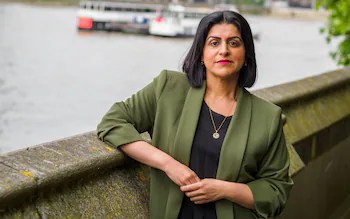
The Justice Secretary, Shabana Mahmood is a Muslim. Her thinking about issues is therefore inevitably shaped by her faith. This means she should not express any opinions about public policy where there is a risk her faith has influenced her.
So runs the argument given voice in Sunday’s papers by Charlie Falconer, the former Lord Chancellor and vocal proponent of assisted dying. I describe it as an argument. This does not quite reflect Lord Falconer’s almost total failure to explain why Mahmood’s perspective is invalidated by having been influenced by her Islam. It is just assumed that it does.
This is wrong but typical. In the rest of this post I want to explain why arguments articulated on the basis of religious reflection are not only valid and helpful when making public policy but are among the best reasons to do or not do something.
- Religious reasons are deep and broad
First, reasons formulated upon the basis of a Christian, Islamic or Judaic faith (to pick the three faiths most influential in the UK) are both deep and broad. Where they overlap with one another they are exceptionally so. What I mean by this is that they are founded on millennia of reflection and reasoning about the most profound realities human beings face. In that sense they are deep.
Public policy issues such as assisted suicide, abortion, poverty relief, war and so on raise profound questions about who human beings are, the nature of their responsibility to one another, to posterity, to a Creator (if there is one). They rely on philosophical questions about the nature of compassion, coercion, consent, dignity, healing and care. Throughout human history almost all the reflection upon these issues has been done by and within faith traditions. To say that one’s views are informed by one’s faith is to say one stands in the line of deep, wise, rich and tested reasoning about the most profound realities.
More than this, where there is agreement between the Roman Catholic, Protestant and Islamic faiths (as in the case of assisted dying), one is struck by the breadth of the wisdom they embody. Together those faiths represent over 2/3 of the global populations. Crowds can, of course, be wrong. But if these faiths embody the wisdom of billions over millennia they are surely at least relevant to public policy questions.
Viewed from this perspective, not only are Mahmood’s religiously informed reasons valid one would have to be mad to disqualify them. Their wisdom is certainly more persuasive and relevant than poorly articulated conceptions of personal autonomy and healthcare economics.
2. Religious Reasons are Inevitable
Second, Lord Falconer’s implicit argument seems to imagine that there are reasons grounded in solid contemporary ethics and informed by (in his case) the Labour movement that are not religiously influenced. This is simply not true.
Falconer’s Labour movement, the values of personal autonomy, compassion and so forth that he supports, all arose in the context of a distinctively Judeo-Christian culture. Tom Holland has demonstrated at length how the values that we take for granted as progressive Westerners reflect deeply Christian convictions about the world and our place within it. This is particularly so for social-justice movements such as the Labour party. That is why Harold Wilson is reputed to have claimed that the Labour Party ‘owed more to Methodism than to Marx.’ In that sense Falconer knows neither his movement nor himself since both are a product or religiously grounded reasons.
The truth is that religious reasons are inescapable. Religious reflection built our society. The deepest intuitions we have are formed by convictions about the value of the individual, the dignity of life (and death), and a myriad other issues that are historically and philosophically contingent upon religious beliefs. All Mahmood is doing is reflecting that reality honestly.
3. Religious reasons are not coercive
Lord Falconer also suggests that for Mahmood to make arguments grounded in spiritual reflection is to impose her religious beliefs on everyone. This is both risible and offensive.
Mahmood is not seeking to coerce anyone to follow Islam. She is arguing about the law on assisted dying should be. If she succeeds (and I pray she does) there will be no more Muslims in England next Sunday than there are this. She is doing exactly what Lord Falconer is doing: making an argument that other people can agree with or not. Moreover, his intervention suggests she is doing so rather better than he is.
If secularists think religiously or spiritually informed reasons for doing or not doing something are wrong, they should explain why. Simply saying they are not admissible displays both fear and arrogance. Either Lord Falconer does not feel able to explain why Muslim, Christian or Jewish perspectives on the sanctity of life and the proper role of compassion are wrong, or (worse) he feels he should not have to do so because they are intrinsically invalid because those who hold them are not thinking hard enough or are not among the permitted class of decision makers. To be blunt, he will only allow a Muslim (or a Catholic) to participate in dialogue if they are willing first to disavow the wisdom and experience of their people. I suspect in this case that both are at play. The first is foolish, the second offensive.
Shabana Mahmood is, like Wes Streeting, a politician of courage, integrity and ability. She thinks deeply, engages wisely, and acts bravely. We need more men and women of faith like them engaged in debates like this if we are to think and act well particularly in matters of life and death.

 Deep Church