How does prophetic evangelism work?

Prophetic evangelism might be easier than you think. It requires listening, responding, and risk-taking.

One of the amazing things about being a Christian, and particularly belonging to the charismatic part of the Church is the belief not only that God sees and guides our lives generally but that he can lead and speak through us as we counsel, support and share his love with others.

We see this in the New Testament both in Jesus’s life and ministry and in the book of Acts. One obvious example is Jesus speaking with the Samaritan woman in John 4. Here the Lord receives insight into the woman’s circumstances and history in a way that shows her that God sees her and knows her. A slightly different type of encounter is recorded in Acts 8. Here Philip is in a place he’s not used to when he feels God’s Spirit provoking him to go to a particular chariot. When he gets there he doesn’t have great insight of supernatural guidance, rather he just shows an interest in the individual he finds there. The prophetic element was in putting him in that place to begin with. Finally, there is the story in Acts 9 of Ananias and Saul. In this story Saul is in bad need of prayer and baptism, of someone to make sense of the profound experience he has held of Jesus but which no one else knows about. Here the prophetic call comes when Ananias hears the Spirit telling him to go and pray with Saul in Jesus’ name for him to receive the Spirit.

These stories can feel a million miles away from our personal experiences. Even for those of us who enthusiastically affirm that the Holy Spirit is at work in and through his Church in much the same way now as he was then, it is hard to translate them into practice. In the rest of this post I am going to suggest a couple of principles we find in these stories which help us to start to experience prophetic leading in our evangelism and pastoral care. Then I will share a couple of stories of how this has worked out in my own (admittedly meagre) experiences.

Principles at Work

Each of these stories has, I think, three things in common that are simultaneously easy and hard for us to imitate.

  1. They all happen to people who are listening to God whether they are talking to someone (Jesus) or in a strange place (Philip).
    In turn this implies that they are paying attention to the impression they feel in their spirit. The voice of God rarely comes in an audible way. More often it is a strong impression that we should do or say something, combined with an awareness that it might not come from ourselves.
    This comes with practice and time spent in worship and prayer. It also means taking off headphones, sitting and being present to God and to the place we are in.
  2. They all involve being willing to take a risk in response.
    It’s great to hear what God might be saying. Then we have to take a risk and do something about it.
    The risk is usually that we will go up to someone and they won’t be interested. Or that we will fail to see any benefit. Or that we will be embarrassed. Or that we will waste our time.
    All of these things will happen sometimes. But unless we are willing to risk them, we won’t ever see the prophetic at work.
  3. They are all focussed on making Jesus’s love present in the moment.
    Prophetic evangelism (or pastoral care, for that matter) is never focused on ‘wowing’ someone or looking good. It isn’t a demonstration of power or ability. Rather it is the precursor to going into a situation in order to minister the love of Christ to someone. 

A Practical Example

So how does this work out in practice? Here’s a very limited and broken example.

Last week my wife and I were in a coffee shop talking about various bits of church admin. At the same time I was looking around and, as I often do, quietly asking Jesus what he was saying.

A lady walked in wearing a traffic warden’s uniform. As we carried on talking, I couldn’t get her out of my mind. Over and over again, the thought came to me that her job was horrible and I should offer to buy her a coffee. 

That’s the listening phase.

After a while of this (about 2 minutes), I got up and went over to the lady as she decided what to order. I said ‘excuse me’ and interrupted her. I asked if she was a traffic warden. She said she was. I explained that I’m a priest (that’s the language I find most people understand better than Elder or Pastor) and that I had been praying for her. I asked if I could buy her coffee for her because her job could be horrible.

She looked surprised and touched. The barista, to be honest, looked completely confused. I paid for the coffee and went and sat down.

That’s the risk-taking phase and love phases. She could have said ‘no’ and I would have felt embarrassed, especially as I was trying to do it in Jesus’ name. But equally if I succeeded, at very least she would have a coffee and know that there were people praying for her and that Jesus is kind.

Then, the twist. This is where the prophetic bit comes in.

After getting her coffee she came back over to the table where my wife and I were sitting. She was emotional and explained that she had been at Alpha in another village the previous night. She was finding life really hard but knew that Someone was holding her and caring for her.

I offered to pray for her and her daughter. She was very glad to accept.

I had no idea about any of this. But God did. He saw her, loved her, and showed her his care at a time when she was seeking him.

Prophetic evangelism might be easier than you think. It requires listening, responding, and risk-taking.

Theology, Wisdom and the Fear of God

Theological writing and debate (let alone preaching) would be immeasurably improved if everyone involved imagined they will have to read out every word we write or say in public, in the presence of Christ and all the saints. 

The badge of my present University includes a Latin motto. I must confess that I had seen it lots of times but never really noticed it until last year. It reads: Initium Sapientiae Timor Domini, the Fear of the Lord is the Beginning of Wisdom. 

It is a quote from Scripture. In Psalm 111:10 we read that:

“The fear of the LORD is the beginning of wisdom;
all those who practise it have a good understanding.
His praise endures forever!”

In other words, you cannot even begin to be wise until you have learned the fear of the Lord. Wisdom depends upon a sense of reverence for God, of respect, of the genuine fear that comes from knowing that someone else is immeasurably more powerful, wise, good and authoritative than you are. 

It is a sentiment that I recognise from my time in court, particularly in the higher courts. Only a fool went into the Court of Appeal (or, I am sure, even more so the Supreme Court) without a healthy fear of the venerable, esteemed, brilliant and ruthless minds one was going to find there. The beginning of making good and wise submissions, of success, was to revere and respect the judges.

I wonder what it would mean for that sentiment to be taken seriously in contemporary theological discussion, writing and debate. 

As I have attended conferences, read papers and responded to them over the last few years I have been first struck, and then alarmed, by the lack of fear of God that accompanies a lot of Western theology. Theological work ought to be characterised by respect for God, by a sense that it really matters and will be judged. It should be underpinned by the knowledge that whatever we say (and of course it will be inadequate), we are seeking to speak of, and on behalf of, the Supreme Judge of the Universe.

This doesn’t mean that we shouldn’t take risks or be willing to disagree and dispute, and think creatively. But our discourse should reflect the fact that how we speak of God matters and that it matters primarily not because it impacts on other people but because God himself matters most of all.

Too much theological work in the West is flimsy. It lacks moral and intellectual seriousness, sometimes shown by a lack of rigour or work. It is willing to speak about God in ways that do not treat him seriously and show a lack of respect for his people, his church and those who have gone before us. 

A Couple of Examples

I think, for example, of a paper I heard presented recently. The burden of the paper, explicitly, was that St Paul was a misogynist. It is an interesting contention, and one that should not be made lightly since it involves an attack on the moral and intellectual character of one of the leading Christian thinkers in history and a man venerated as a servant of God in every part of the church. It also involves impugning the moral credibility and reliability of Paul’s writings, particularly in the New Testament.

These would be big charges to bring against anyone, let alone someone of the intellectual and spiritual stature of Paul. Yet the paper tried to argue for Paul’s misogyny on the basis of a single passage (1 Corinthians 15 in case you’re interested), extracted from its context, without addressing (or even, I checked in questions, considering) the intention of that passage or alternative interpretations of it. The paper didn’t even address or reflect upon what Paul said in the rest of that letter.

There are interesting questions about how Paul deals with men and women, and particularly how we apply that in the contemporary church. But the paper didn’t seem to be a good faith attempt to ask them. It was a hatchet job given without any sense that the way one speaks about God’s servants, or Scripture, has any consequences at all. There was no fear of the Lord.

Others have identified similar trends in different parts of the church. Mark Bauerlein at First Things wrote a brilliant piece addressing the way that Professors in New Testament Theology (in this instance in a Roman Catholic context) use Queer Theory and other branches of Critical Theory in their studies of the New Testament.

Conveying what the New Testament author actually meant, let alone putting a particular text in its ecclesial and canonical context, has ceased to be the primary goal. Instead the primary goal is to demonstrate the writer’s sophistication and facility with whatever contemporary interpretative fad presently holds sway.

Again, there is precious little evidence that theology as a discipline, or the ideas that it proposes matters. But they do. They matter because God does.

The Fear of Human Beings

In Proverbs 29:25 a second type of fear is identified, the fear of human beings. That type of fear is, we are told, “a snare”. To be anxious about what people think of us is a trap. And it is one we fall into again, and again, and again.

In this context, the location of theological discourse in the Academy (where funding often depends on demonstrating social utility), and the missional desire to bring people close to Jesus, is a major risk. When the primary driver of our work is whether we are going to be approved by other people (and particularly by those outside the church), and the criteria of a good or bad point is that approval, then we are at risk of going wrong. We are facing the wrong audience, seeking the wrong endorsement, trying to be relevant to the wrong issues.

This isn’t to adopt the classic conservative rhetorical approach of denouncing anyone who isn’t abrasive or rude to their opponents as displaying the “fear of man”. Sometimes it is good to get along with people and to be wise and discerning about what we say (just look at St Paul before Festus and Agrippa in Acts 25). We must, of course, be respectful and kind as far as we are able. Moreover, good theology will always end up serving people and the mission of the church.

But there is such a thing as showing too much respect to human beings. Ultimately the most important thing in theological debate and writing is to speak faithfully and well of God for his sake. People come second. 

In this we are following the example of Jesus who put the commandments into exactly that order: 

Jesus replied: “‘Love the Lord your God with all your heart and with all your soul and with all your mind.’ This is the first and greatest commandment. And the second is like it: ‘Love your neighbour as yourself.’ All the Law and the Prophets hang on these two commandments.” (Matthew 22:37-40)

First God. Then people.

Practical Pay Off

What might this mean in practice for theological writing and debate?

I propose a simple rule that helped immeasurably when we were involved in litigation:

All of us involved in teaching, research and preaching should imagine that we will have to read out every word we write or say in public, in the presence of Christ and before all the great theologians of history. 

If anything is likely to root us in the fear of the Lord, and therefore in wisdom, it is that. It also has the advantage of being absolutely true.

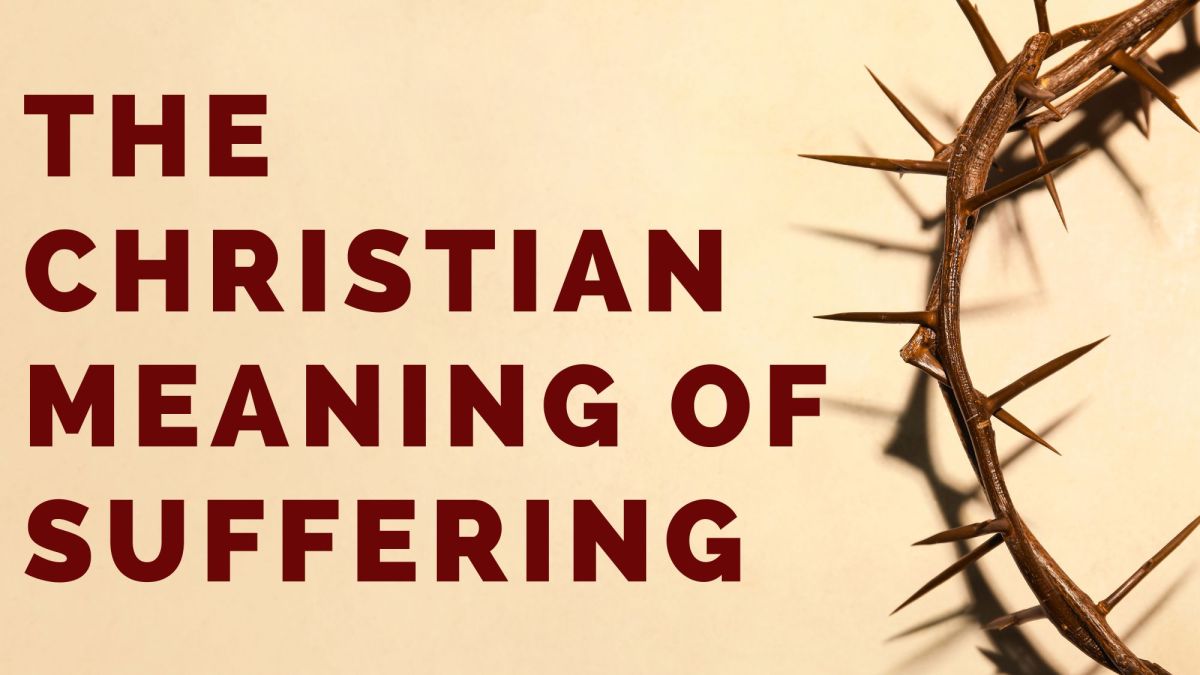
The Christian Meaning of Suffering

Suffering is a part of the human condition and is evidence of evil. Yet Christ has walked that path, can meet us in the midst of suffering and use it to bring goodness and salvation in us.

I want, in this post, to think about suffering. And, in particular, suffering as a Christian.

This isn’t an easy topic to address. Often, as Job’s friends found, we are too quick to speak when others are in pain.

Yet as a pastor I encounter suffering a lot. I, of course, experience my own pain and struggles with bereavement, depression and physical illness. I also have the privilege and burden of walking through dark valleys with others and trying to help them see Christ even in the midst of their difficulties.

The way of Jesus speaks to these times as loudly (and perhaps louder) as it does to times of blessing and joy.

Before we go any further I need to acknowledge that much of what I am saying today is influenced by the work of a much greater mind and teacher than myself: Pope (now St) John Paul II in his letter On the Christian Meaning of Human Suffering. It is hard going in places but is the product of a one of the great modern theologians and philosophers; I recommend it.

Summary

Whenever I preach or write, I always try to think about a summary of what I’m going to say, distilled down into a sentence or two. Here’s today’s:

Suffering is a part of the human condition and is evidence of evil. Yet Christ has walked that path, can meet us in the midst of suffering and use it to bring goodness and salvation in us.

The Nature of Suffering

My own reflections on suffering in this context began with the story of Jesus healing a blind man in John 9.

The account opens with Jesus seeing a man who was suffering. He suffered physically – he had never been able to see – and economically – he was a beggar.

The man’s situation began to prompt the questions that sooner or later come to everyone: why? Why is there this pain? What is the meaning of it?

These questions are universal. To experience suffering is a uniquely human thing. Animals experience pain, certainly. But they are not aware of themselves and of their pain. The mental aspect is not there and so the experience is fundamentally different.

The problem of pain is not easy to answer.

When faced with, or experiencing, suffering it is tempting, as the disciples showed, to reach for the language of blame. Surely it must be this man’s fault? Or if not him then his parents?

Jesus resists that line of logic: Sometimes suffering is the direct result of human sin – either our own or someone else’s. We don’t have to think for long to come up with examples.

But often, perhaps much more often, we suffer and there is no one directly to blame. It is fruitless to cast around for villains to accuse. Jesus doesn’t bother with that here.

Suffering isn’t always the direct result of sin but it is indicative of the presence of evil. Evil, in Christian thought, comes from a lack of, or the absence of, a good. We suffer because of a lack of something we need.

In that sense our experience of suffering is a pointer to the fact that the world is not as it should be – that it has gone wrong in some way that we cannot fully grasp.

That is why the problem of evil is so profound and also why it is ultimately evidence for the existence of God. After all, on an atheist view of the world in which all there is can be reduced to mere matter, there is no explanation for why we experience pain as “bad”. “Bad” and “good” are meaningless, non-existent ideas. For the atheist, there is no reason to believe we ought not to experience pain.

We intuitively know this is not true. Everything within us revolts at the suffering we experience and see around us. “This should not be” scream our hearts as the memory buried deep within us of a Creator who loves us and does not want this for us stirs within.

Jesus’s Response to Suffering

Suffering, then, is profoundly linked to our experience of being human. It speaks of evil but is not always (or even often) a direct response to anything we, as individuals, have done.

What is God’s response to that suffering? What is his response to any form of evil?

For Christians the answer begins and ends with Jesus.

The heart of Christianity is Jesus’s claim that:

For God so loved the world that he gave his one and only Son, that whoever believes in him shall not perish but have eternal life. For God did not send his Son into the world to condemn the world, but to save the world through him.[1]

In other words, God sees the world of evil and death, of pain and suffering, and offers himself in Christ to bear it, to confront it and to redeem it.

In Jesus, the Son of God, was willing to step into our world to face its evil and to bear its suffering, to bear our suffering, in order that he might save us.

Isaiah, the Old Testament Jewish prophet, predicted exactly this in a stunning piece of poetry that anticipated and described how the Messiah would come and suffer with us in order to redeem us.

In Christ, therefore, suffering is no longer a place forsaken by God, bearing the darkness of death and rejection of good. Rather it is a path that God himself has trod and which he has used to bring life.

In a small way we see this marked out in John 9.

  • Who saw the blind man? Jesus. Jesus sees us in our pain.
  • Who healed the blind man? Jesus. Jesus is the one who comes to fix our pain.
  • Who found the man when everyone else rejected him? Jesus. Jesus is the one who finds us and comforts us in our suffering.
  • Who would be tried by the same court, and bear the weight of their rejection and scorn? Jesus.

God’s response to suffering is not to deny it but to walk through it in order that it can be turned to good.

Encountering Christ in and Through Suffering

Now we should notice that suffering does not stop because we have become Christians. That is never promised, nor should it be expected.

Jesus told us that those who wish to receive his life must first take up their cross and follow him. The path of a follower Christ is inextricably linked with suffering even as his own path was.

In our reading the blind man obeys Jesus and receives a huge blessing in the grant of his sight. Yet immediately his suffering switches from disability and poverty to rejection and exclusion.

At the end of the story, however, it is he who has been accepted, has received light and no longer lives in darkness, while those who were powerful and apparently healthy have been revealed to be blind.

The man’s suffering has remained a source of pain and grief. Yet it has become an opportunity for him to encounter Christ. It is through his trials and his pain that he comes to see and understand who Jesus is and to receive the life that he offers.

Christians suffer even after they have come to Christ.

Yet, our suffering now is not hopeless or meaningless. Rather it can be an opportunity for us to encounter Christ (who himself walks through suffering) and so to come to a deeper understanding of him and in turn be changed to be more like him.

As we suffer as Christians, we are united, in a deep way, with the experience and life of our Master. That does not mean that our pain is not real, our frustrations not deep anymore than his were.

Rather it means that God is there with us in the midst of it, sharing it, and using it to bring us closer to him and to work something of his redemptive power in us.

In Salvifici Doloris, Pope John Paul explains that:

Suffering is, in itself, a trial of evil. But Christ has made it the most solid base of the definitive good, namely of the good of eternal salvation. By his suffering on the Cross, Christ reached the very roots of evil: those of sin and death. He has overcome the author of evil which is Satan, and his permanent rebellion against the Creator. To his suffering brother or sister, Christ opens and gradually unfolds the horizons of the Kingdom of God: of a world converted to the Creator, of a world liberated from sin, which is being built on the saving power of love. And slowly but surely, Christ introduces suffering man into this world, into this Kingdom of the Father, in a certain sense via the very heart of his suffering. Indeed, suffering cannot be transformed and changed by a grace from outside, but from within. 

St Paul puts it like this:

For just as we share abundantly in the sufferings of Christ, so also our comfort abounds through Christ.[2]

We are hard pressed on every side, but not crushed; perplexed, but not in despair; persecuted, but not abandoned; struck down, but not destroyed. We always carry around in our body the death of Jesus, so that the life of Jesus may also be revealed in our body. For we who are alive are always being given over to death for Jesus’ sake, so that his life may also be revealed in our mortal body.[3]

The End of Suffering

Ultimately, Christian hope is not merely that suffering itself can be redeemed and recast as an occasion either for our own encounter with Christ or for love to be demonstrated between people.

The final consolation, the final reassurance, for those who suffer with Christ is that this pain is not the final word. Nor, does it ultimately lead to death. Rather when we walk this road with Jesus, we can be assured that our journey ends in life; abundant, overflowing life.

We are people who not only see Christ crucified, bearing the weight of our suffering and sin on his shoulders, but Christ raised, offering light and hope to all who will receive it. He came into the world so that that light may be offered to all who are in darkness.


[1] John 3:16-17

[2] 2 Corinthians 1:5

[3] 2 Corinthians 4:8-11