The Benefit of the Doubt

Doubt is not always bad. If we handle it in the right way, doubt can spur us on to a richer, more satisfying and deeper faith.

Doubt is not always bad. If we handle it in the right way, doubt can spur us on to a richer, more satisfying and deeper faith.

Everyone experiences doubt at some point in their lives. This can affect our relationships with each other. Drawing on his own counselling ministry and research, the Christian writer and philosopher, Gary Habermas, observes in his excellent Dealing with Doubt that ‘Doubts concerning the ideas or persons most important to us might be called an almost universal fact of life.’ 

This is true both for religious people and atheists, for matters of faith and any other area of life in which we have to deal with things of significance. 

CS Lewis reflected on his own experience of periods of doubt as both an atheist and a Christian:

‘Now that I am a Christian I do have moods in which the whole thing looks very improbable; but when I was an atheist I had moods in which Christianity looked terribly probable.’

Uncertainty is a part of human existence. That means that doubt is, too.

Doubt is not always bad. As we will see, Jesus doesn’t condemn it in the disciples. Moreover, if we handle them in the right way, periods of doubt can spur us on to a richer, more satisfying and deeper faith.

We should also note that doubt isn’t simple. We can be tempted to imagine that it is always an intellectual phenomenon. In reality, those involved in counselling people experiencing periods of doubt in different contexts have found that there are actually different types of doubt, each of which requires its own response.

In this passage we see Jesus’ response to three types of doubt.

  1. Doubt in the emotions
  2. Doubt in the mind
  3. Doubt in the will

Emotional Doubt

In Luke 24:36 Jesus’s first words to his disciples when he appears to them after his resurrection are ‘peace to you’

The first species of doubt is emotional. This is where doubt arises largely from our feelings rather than a particular intellectual problem. Habermas estimates that more than ⅔ of doubt he has come across in church is actually emotional.

Doubt can often seem to be about ideas when actually it is about feelings. 

This is a classic example. The disciples have been through a terrible trauma. They are utterly exhausted. They are also scared, probably angry, have been betrayed by their mate, and seen everything they believe in apparently crash around their ears.

They are having a very bad week.

In the midst of tiredness, hunger, and pain we can begin to doubt in a visceral way.

Lewis expresses it in this way:

Our faith in Christ waivers not so much when real arguments come against it as when it looks improbable–when the whole world takes on that desolate look which really tells us much more about the state of our passions and even our digestion than about reality.

When we experience this type of doubt we need to be healed, not persuaded. That is why Jesus just says: ‘Peace be to you.’

This healing has three parts:

  1. Physical:
    Get some sleep. Take some time off work if you are burnt out. Do something fun. Eat well.
    For example, I never take seriously anything I think after 10pm. It’s tiredness talking.
  2. Mental:
    If you are assailed by an idea you know to be false (like I’m too awful for God to love), identify the idea, name it, and challenge it with truth. Memorising Scripture is good for this.
  3. Spiritual:
    Learn to pray, particularly contemplative prayer. If you struggle to think of ways to pray, speak to me. 

Intellectual Doubt

Second, we can experience doubt in our minds. 

This is what is going on in Luke 24:37-39. The disciples are struggling to believe that someone really could rise from the dead. They can’t get their heads around it. So Jesus offers them evidence to explore.

Every thinking Christian at some point will have questions about the faith.

They might be about the reliability of the gospels: how do we actually know that Jesus lived and died and rose from the dead?

They might be about the existence of God: what arguments are there for believing that there is something more than the material world?

They might be about specific questions such as the problem of evil or reconciling scientific discoveries with the content of Scripture and the faith.

These questions are not new – they have been well canvassed by some of the most brilliant minds in the history of the world, from both science and philosophy. And many of those asking these questions end up as Christians.

So how do we deal with this type of doubt:

  1. Maintain a strong devotional life.
    Staying in the Scriptures, and have a regular pattern of prayer feeds our minds and our souls.

Lewis said:

…make sure that, if you have once accepted Christianity, then some of its main doctrines shall be deliberately held before your mind for some time every day. That is why daily prayers and religious reading and church-going are necessary parts of the Christian life. We have to be continually reminded of what we believe. Neither this belief nor any other will automatically remain alive in the mind. It must be fed.

  1. Look for answers.
    Jesus offers his disciples evidence for his claims. There is really, really good evidence for Christianity.
    The questions we have are ones that brilliant minds have considered (not least Lewis himself). If you are really struggling with doubt in your minds about a particular question, look into it.
  2. Be patient.
    None of us is that smart and we need to be patient if we don’t get everything right away. Some things are really difficult. God is really big. We are really small.
    That doesn’t mean don’t apply your mind. It does mean having a healthy humility about your capacity to reason to the answer on every question in your own time.

Doubt in the Will

The third type of doubt flows from the will.

This means that God is asking us to do something we don’t want to do. It is usually characterised by knowing the facts but not being willing to do the thing they seem to imply.

This is suggested by what Jesus says in Luke 24:46-49

By this stage the disciples know that Jesus is alive. The question is, are they going to go and tell anyone about him?

Types of challenge that can cause this species of doubt can include ethical problems (I really want to sleep with my boyfriend even though I know I shouldn’t), to come to church (I know I should go but I want to stay home) or missional (I know God wants me to do something for him but I don’t want to).

This type of challenge can lead to doubt. It isn’t a rational process: we rarely think ‘I don’t want to do [X]  so I don’t believe anymore’.

Rather it manifests itself in raising up small, ‘picky’ issues that on any objective view aren’t really relevant to a life of faith or in refusing to accept, or even really consider, any answers or explanations that are given to apparent problems. The dispeace or uncertainty therefore continues and nothing can touch it.

This happens because faith isn’t just a question of belief but of action. It implies a choice about what I will do – what Paul describes as the obedience of faith.

How do we address this type of doubt? Jesus’ response to the disciples suggests two things:

  1.  We need to exercise our wills.
    Ultimately only we can choose to follow Christ. By God’s grace, every one of us has that agency. We are treated like grown-ups.
    It can be hard, painful and require the support of friends. But the choice is ours. 
  2. We need the Holy Spirit.
    Christ knows that the task is too difficult for them to do on their own. It is too difficult even to begin on their own. I think that is not only because they need the power to do it. It is because they need the courage to choose it.
    This implies prayer. When we are facing a hard choice, we need to be those who come to Jesus and ask for the Spirit’s power to choose well. Or even to desire to choose well. Don’t underestimate the power that is available to one who seeks it.

Application

I’ve offered ideas about how we respond in each of these areas as we have gone along. Nevertheless, I want to close by offering some general principles for dealing with doubt.

  • Keep together.
    Doubt, whether in our minds, emotions or wills is not something to be ashamed of or gone through alone. Talk to people.
    Obviously, be careful who you speak to if it is personal. But this is part of why God puts us in churches.
    For example, if you are wrestling with the problem of evil or the relationship between Creation, evolution and Scripture, come and talk to a pastor or theologian. You can even email me. I won’t judge you; the chances are I have thought about the same things. 
    If stuff is hard emotionally and you are starting to doubt your faith, talk to a friend or life group. You might find something as simple as a hug, or crying with them, makes a huge difference. Or it might take much longer.
    But use each other.
  • Keep praying.
    Above all else, keep Christ before you. If you are wondering if it’s worth it, I would ask: why not? What are you losing by continuing to pray and to come to church? And often it is through prayer and worship that we find ourselves united to Christ in a way that relativises all our doubts.
  • Keep humble and be patient.
    Always remember how small even the smartest and most together of us are compared to God, the universe and the things we are dealing with.
    There is such a big temptation to want to rush to conclusions or take immediate action in response to every thought. I cannot stress how important it is to resist that temptation.
    Be patient. With yourself, with God, with the answers. Stuff takes time to heal, to find, to understand and to accept.

Doubt is not always bad. If we handle it in the right way, doubt can spur us on to a richer, more satisfying and deeper faith.
How does prophetic evangelism work?

Prophetic evangelism might be easier than you think. It requires listening, responding, and risk-taking.

One of the amazing things about being a Christian, and particularly belonging to the charismatic part of the Church is the belief not only that God sees and guides our lives generally but that he can lead and speak through us as we counsel, support and share his love with others.

We see this in the New Testament both in Jesus’s life and ministry and in the book of Acts. One obvious example is Jesus speaking with the Samaritan woman in John 4. Here the Lord receives insight into the woman’s circumstances and history in a way that shows her that God sees her and knows her. A slightly different type of encounter is recorded in Acts 8. Here Philip is in a place he’s not used to when he feels God’s Spirit provoking him to go to a particular chariot. When he gets there he doesn’t have great insight of supernatural guidance, rather he just shows an interest in the individual he finds there. The prophetic element was in putting him in that place to begin with. Finally, there is the story in Acts 9 of Ananias and Saul. In this story Saul is in bad need of prayer and baptism, of someone to make sense of the profound experience he has held of Jesus but which no one else knows about. Here the prophetic call comes when Ananias hears the Spirit telling him to go and pray with Saul in Jesus’ name for him to receive the Spirit.

These stories can feel a million miles away from our personal experiences. Even for those of us who enthusiastically affirm that the Holy Spirit is at work in and through his Church in much the same way now as he was then, it is hard to translate them into practice. In the rest of this post I am going to suggest a couple of principles we find in these stories which help us to start to experience prophetic leading in our evangelism and pastoral care. Then I will share a couple of stories of how this has worked out in my own (admittedly meagre) experiences.

Principles at Work

Each of these stories has, I think, three things in common that are simultaneously easy and hard for us to imitate.

  1. They all happen to people who are listening to God whether they are talking to someone (Jesus) or in a strange place (Philip).
    In turn this implies that they are paying attention to the impression they feel in their spirit. The voice of God rarely comes in an audible way. More often it is a strong impression that we should do or say something, combined with an awareness that it might not come from ourselves.
    This comes with practice and time spent in worship and prayer. It also means taking off headphones, sitting and being present to God and to the place we are in.
  2. They all involve being willing to take a risk in response.
    It’s great to hear what God might be saying. Then we have to take a risk and do something about it.
    The risk is usually that we will go up to someone and they won’t be interested. Or that we will fail to see any benefit. Or that we will be embarrassed. Or that we will waste our time.
    All of these things will happen sometimes. But unless we are willing to risk them, we won’t ever see the prophetic at work.
  3. They are all focussed on making Jesus’s love present in the moment.
    Prophetic evangelism (or pastoral care, for that matter) is never focused on ‘wowing’ someone or looking good. It isn’t a demonstration of power or ability. Rather it is the precursor to going into a situation in order to minister the love of Christ to someone. 

A Practical Example

So how does this work out in practice? Here’s a very limited and broken example.

Last week my wife and I were in a coffee shop talking about various bits of church admin. At the same time I was looking around and, as I often do, quietly asking Jesus what he was saying.

A lady walked in wearing a traffic warden’s uniform. As we carried on talking, I couldn’t get her out of my mind. Over and over again, the thought came to me that her job was horrible and I should offer to buy her a coffee. 

That’s the listening phase.

After a while of this (about 2 minutes), I got up and went over to the lady as she decided what to order. I said ‘excuse me’ and interrupted her. I asked if she was a traffic warden. She said she was. I explained that I’m a priest (that’s the language I find most people understand better than Elder or Pastor) and that I had been praying for her. I asked if I could buy her coffee for her because her job could be horrible.

She looked surprised and touched. The barista, to be honest, looked completely confused. I paid for the coffee and went and sat down.

That’s the risk-taking phase and love phases. She could have said ‘no’ and I would have felt embarrassed, especially as I was trying to do it in Jesus’ name. But equally if I succeeded, at very least she would have a coffee and know that there were people praying for her and that Jesus is kind.

Then, the twist. This is where the prophetic bit comes in.

After getting her coffee she came back over to the table where my wife and I were sitting. She was emotional and explained that she had been at Alpha in another village the previous night. She was finding life really hard but knew that Someone was holding her and caring for her.

I offered to pray for her and her daughter. She was very glad to accept.

I had no idea about any of this. But God did. He saw her, loved her, and showed her his care at a time when she was seeking him.

Prophetic evangelism might be easier than you think. It requires listening, responding, and risk-taking.

What Is the Future of the Church?

We don’t need a church that celebrates the cult of action in political ‘prayers’. It is quite superfluous…the future of the church, this time as always, will be shaped anew by the saints. By people who are aware of more than mere phrases, people who are modern but have deep roots and live in the fullness of the faith.

We don’t need a church that celebrates the cult of action in political ‘prayers’. It is quite superfluous. Therefore it will collapse of its own accord. From today’s crisis this time too a church of tomorrow will rise, which will have lost much. It will become small, and to a large extent it will have to start again from the beginning. It will no longer be able to fill many of its buildings that were built in times of prosperity. Because of the number of its adherents it will lose many of its privileges in society. Unlike in the past, it will present itself much more strongly as an optional community, which can only be joined through a decision to do so. It will surely find new forms of office and ordain reliable Christians as priests, who also have other jobs. But, as before, full-time priests will be essential too.

The future of the church will not come from those who just follow recipes. It will not come from those who just want to choose the easy way. Those who avoid the passion of the faith and call anything demanding false and obsolete, tyrannical and legalistic. To put it positively: the future of the church, this time as always, will be shaped anew by the saints. By people who are aware of more than mere phrases, people who are modern but have deep roots and live in the fullness of the faith.

But despite all these changes which we can imagine, the church will again decisively find its essential being in what has always been its heart: faith in the triune God and in Jesus Christ. It will be an inward church, which does not bang on about its political mandate and flirts as little with the left as with the right. It will rediscover its own core in faith and prayer and experience the sacraments again as divine service, not a problem of liturgical design. The church will find it hard-going. For the process of crystallization and clarification will cost it much labour. It will become poor, a church of the little people.

The process will be long and difficult. But after the test of this letting go, great power will stream from a church that has been taken to heart and become simplified. For the people of a wholly planned world will become unutterably lonely. When God has disappeared from them, they will feel all their terrible destitution. And then they will discover the little community of believers as something completely new. As a hope that takes root in them, as an answer, which they have always secretly been seeking – as a home which gives them life and hope beyond death.

Joseph Ratzinger, Glaube und Zukunft (Munich, 1970) (quoted in Peter Seewald, Benedict XVI: A Life (Volume 2), p.70)

How Does God Love the World?

This is how God loved the world, he gave his only Son that whoever puts their trust in him shall not perish but have eternal life.

Love is a big deal for Christians. It’s because of the centrality of love to Christianity that it appears so prominently in our culture. We all love to love.

But as soon as we say this, it begs the question: how? How does God love the world? What does ‘love’ mean in that context? In culture, ‘love’ is often a synonym for sex. Yet at the same time grown men will say they ‘love’ their football teams.

When Scripture talks about God loving the world it has something very powerful and particular in mind. It isn’t something that can adequately be summed up in words – it has to be shown rather than told.

The best I can do is to say that love consists in choosing to give oneself completely for the good of another. Thus, in John 3:16 we read that, God loves the world by giving his only Son that whoever puts their trust in him shall not perish but have eternal life.

That’s an idea that is quite easy to repeat. It is sufficiently well known that the wrestler, Stone Cold Steve Austin, used to parody the endless references to it on signs at Wrestlemania with his own version: Austin 3:16.

The rest of this post is trying to explain what these verses actually mean and why they matter.

I’m not going to quote John 3 here. But the rest of this post will make a lot more sense if you have read it.

  1. What’s Going On Here?

Our scene opens at night. That is significant. It is dark. As you read John’s gospel you will notice that he often mentions light and darkness as symbols of a spiritual or mental awakening. For example, we are told in John 1 that Jesus is the light that shines in the darkness.

So we are on the alert for someone who does not understand – who is, so to speak, “in the dark” and to whom Jesus is going to bring light.

Into the scene comes Nicodemus. Nicodemus is a very senior leader and religious teacher in Israel. He is part of the council that runs Jewish religious life and is a brilliant man.

I find this story so poignant.

Here is someone who is faithful, who is clever, who has worked hard and achieved an enormous amount. But even with all of that he knows he needs Jesus. He has seen something in Christ that goes beyond all the power and all the prestige and all the wisdom he has acquired. And he knows he needs it.

Whether you are the Teacher of Israel or a street Prostitute, eventually you have to come to Jesus and ask for help.

I love Nicodemus. I love his humility. I love the way a supreme official in the religious hierarchy has come to sit down with a provincial street preacher in order to ask him about the Kingdom of God. He reminds me of the best of brilliant people.

Nicodemus comes to Jesus and asks him about what Jesus is doing. He and his colleagues have seen Jesus at work and they get there is something going on here. But they don’t quite grasp its implications.

Maybe that is how you feel about church or Christianity. There is something you have seen that you recognise as good. It might be a feeling you get in worship, a peace that comes when you pray or hike, or a deep hunger you can’t quite understand (like an itch you can’t reach) but which seems to be satisfied when you listen to the Bible. 

If that resonates with you then you are the type of person Jesus is speaking to in this conversation.

  1. Why Jesus Came

Jesus tries two ways of explaining this to Nicodemus. 

First, he says, getting into God’s kingdom is like having a fresh start, almost going right back to the beginning, like you are born for a second time. But instead of this being a physical birth, it comes from two things: God’s Spirit moving on you and you being baptised; from Spirit and water.

Nicodemus doesn’t get that metaphor. So Jesus reaches for something he is very familiar with – the Old Testament.

There is a story of the people of Israel in the desert after God had set them free from Egypt and before they had entered the land they would call home. They were bitter and angry and complained about God, about being set free, about the food they had and the lives they lived. They began to reject God as provider and leader and look back towards the slavery of Egypt.

And so God allowed an invasion of snakes to come into their camp. They were biting the people and causing pain, even death. The people were sick. 

God provided a way out for them. He commanded Moses to make a bronze snake and put it on a pole. Moses lifted it in the air. Whoever looked up to the bronze snake was healed from the effect of the snake bites.  It was as if the bronze snake had taken all the effects of the snake bites into itself and the people could be healed.

This is what the kingdom of God is like, Jesus says. In fact this incident was put there in the Old Testament so people like Nicodemus could recognise this moment when it came and know what they should do about it. 

Human beings are sick and they are dying. They are dying from the inside out – spiritually killed by the decision to reject God and to turn inward to selfishness and pride. This is what we call sin – the human propensity to mess things up, particularly our relationship with God and each other.

And so Jesus has come, and would be lifted up on a cross and die, punished as a sinner, taking all the world’s sin on himself and offering healing to everyone who would look to him.

Notice three things about this description:

  1. The people aren’t condemned by Jesus.
    They are sick already. It is their choices, our choices, which kill us. That is why Jesus didn’t come into the world to condemn the world but to save it. The world is already dying. Naturally we are already dying, mortally wounded by a thousand rebellions, petty hurts, treasured prides and self-centredness. 
  2. It is God who takes the first step to redeem us.
    Jesus came to us, we didn’t go to him. The point about the bronze snake is that God (through Moses) gave it to the people so that they could be healed. This is what we call grace – the free gift of healing and forgiveness and a future. It isn’t earned, like exchanging a day’s labour for a fair wage. It is given, like receiving medicine.
  3. It has to be accepted and trusted.
    The gift has to be received. It has to be trusted. The people had to look up, away from themselves, away from the snakes, away from their staffs and solutions, and trust the provision God made.
    This is what we call faith. To paraphrase St Thomas Aquinas, it is the response of trust to the testimony of someone we believe. The way Jesus (and the Church after him) teaches we should exercise this trust is by turning away from ourselves and being baptised; be born of Spirit and water.
  1. Why Do We Choose (or Not Choose) the Light?

The conversation finishes with John (or possibly Jesus – the Greek is unclear) explaining how people react to this. 

We can react in one of three ways.

  1. We can hold on to our sin because of shame (misunderstanding what the light is there to do – he came to save, not condemn).
  2. We can refuse the light because we actually prefer our sin. This gets worse the more we choose darkness. When we refuse the light, it gets harder to choose it next time. 
  3. We can choose to say yes to the light and find it brings healing. This has the opposite effect- we find the light is pleasant and good and so the more we choose it, the easier and more desirable it is to choose it again.

Application

What does this mean for us?

  • The first response is for those who haven’t yet trusted themselves to Jesus. Maybe you’re one of those, like Nicodemus, who senses there is something good, vital, even divine about what Jesus says and does. God’s word to you is that he loves you and came for you.
    But you need to know that the yearning you feel is a symptom. It’s like a hungry body’s craving for food, a thirsty man’s need for water. Your soul is sick and it craves the cure.
    Put your trust in Jesus, be baptised, and you will receive a new start and a new life.
  • What about showing hope to others? Here we need to remember that Jesus came to a world that hadn’t asked for him but needed him. He came in love, to bring help and healing to people who had rejected him.
    Ask God to show you who needs your help. And then give it. That is the way of God.
  • Finally, what about sharing hope? Learn from the way Jesus deals with Nicodemus. He listens to him, knows him, and talks to him in a way he can understand. The first step to sharing Jesus effectively with others is to listen to them.

How Can We Follow a Good God in a World of Pain?

Precisely because Auschwitz exists, we need faith, we need the presence of the Resurrection and of the victory of love; only the Resurrection can make the star of hope rise that allows us to live.

This is a question everyone wrestles with at some time or another. Here’s what Joseph Ratzinger, whose family were persecuted by the Nazis, addressed the subject in a talk to those about to be ordained to the priesthood:

The answer to an oft-asked question became clear to me as well. How often has it been said: Can anyone still believe in a good God after Auschwitz? I understood: Precisely because Auschwitz exists, we need faith, we need the presence of the Resurrection and of the victory of love; only the Resurrection can make the star of hope rise that allows us to live.
Making the Resurrection present—my dear young friends—this in fact describes completely the essence of what being a priest means. It means, most profoundly, being able to bring about this reality on the killing field of this world, in which death and its powers reap a continual harvest; it means bringing about the presence of the Resurrection and, thus, giving the answer of life that is stronger than death.
1

In turn, this changes the way that we see evil. We mourn and fight it but regard it ultimately as a defeated and vanquished foe. Thus, as Ratzinger returned to Auschwitz-Birkenau and celebrated the Eucharist, he found his perspective changed:

Making the Resurrection present… It was an exciting thought and an exciting experience, over this vast harvest field of death, on this killing field on which over a million people met their death, to live to see the presence of the Resurrection as the only true and only sufficient answer to it. It was exciting to experience how this memorial to hatred and inhumanity became a place of the triumph of the love of Jesus Christ and of love.2

  1. Ratzinger, Teaching and Learning the Love of God, p.95. ↩︎
  2. Ratzinger, Teaching and Learning the Love of God, p.94. ↩︎

Is Christianity Good for Diversity?

Jesus creates, commands + delivers the most diverse movement in human history. If you value diversity, follow Jesus.

This year I’m writing a series of talks thinking about big questions that lots of us have about Christianity, Jesus and faith. Some of them are about how we can live well, some are doubts we often have but don’t know how to express.

In preparing these talks I have used a book that I whole-heartedly recommend: Rebecca McLaughlin’s, “10 Questions Every Teen Should Ask (And Answer) About Christianity”

Everything I’m saying, Rebecca said first and better. In fact, more than that, I want to urge you to get and read, particularly if you are under 25 (but also if you’re older than that).

Summary (TL;DR)

I always try to give a summary of what I’m going to say in one or two sentences so it is easy to remember. Here is today’s:

Jesus creates and delivers the most diverse movement in human history. If you value diversity, follow Jesus.

  1. Jesus Creates Diversity (or why believing in the dignity and equality of all depends on there being a Creator).

For Jews and Christians, the equality of every person, whatever their race, ethnicity or background is rooted in our belief that every person is made in the image of God. That is why they are worthy of respect.

To be made in God’s image doesn’t particularly mean to look like him physically. It means to be like him, to reflect something of his character and what he is like. Jesus did this perfectly. St Paul tells us that he was the exact image of the invisible God.

If you want to know what God is like, look at Jesus.

That applies perfectly to him but in a distorted and different way to every human being.

This belief is the foundation of all modern movements for equality, inclusion or justice.

Secular society takes for granted that everyone is of equal worth and dignity. But that idea comes from the Christian (and Jewish) commitment to the concept that everyone is made in God’s image.

This is a historical fact.

Historian Tom Holland explains that the idea of human rights – that human beings are equal and all of value arose specifically out of Christianity in Europe.

It was Christians, reflecting on the central idea of Genesis 1:27 (that humanity is made in God’s image), who argued for this. And in doing so they changed the world. Without that, and without the idea that human beings are made in God’s image, it wouldn’t have happened at all.

In case you think Tom (who isn’t himself a Christian) and I are making this up, we know what happens when you reject the idea that human beings are made in God’s image.

In 1859, Darwin published his book, commonly called On the Origin of Species. It’s full title was actually: On the Origin of Species by Means of Natural Selection, or the Preservation of Favoured Races in the Struggle for Life

In it Darwin specifically commented that:

The western nations of Europe … now so immeasurably surpass their former savage progenitors [that they] stand at the summit of civilisation … The civilised races of man will almost certainly exterminate, and replace the savage races through the world.1

This led to the Eugenics movement (getting rid of the weak), to scientific racism and then inevitably to Nazism and the attempt to exterminate the entire Jewish race.

This isn’t to reject evolution as a scientific idea. It may well be a brilliant description of a tool that God, as the great designer and Father of all, has used to shape the world around us. (For what it’s worth, I can quite see how the development of speciation fits with Genesis’ symbolic description of humanity formed from the earth and yet filled with the presence of God but I wouldn’t insist upon it).

But a solely material picture of human origins without God in the picture gives us no reason to believe in equality or dignity – and every reason to reject it.

Without the Christian commitment to the idea that God made us and that we all bear his image, then we are left with no reason to believe in equality, in dignity, in diversity at all.

This has been taken up by the contemporary historian, Yohann Harari. Harari rejects the idea that human beings are made in God’s image. He is a materialist. And that means he doesn’t believe in human rights or equality as anything other than a nice idea:

“The Americans got the idea of equality from Christianity, which argues that every person has a divinely created soul, and that all souls are equal before God. However, if we do not believe in the Christian myths about God, creation and souls, what does it mean that all people are ‘equal’?”2

We believe in equality, in diversity, in the rights of all, because we are Christians. 

Jesus creates and delivers the most diverse movement in human history. If you value diversity, follow Jesus.

  1. Jesus Delivers Diversity (or why Jesus is the root of movements for justice).

So it is a Judeo-Christian view of humanity, made in God’s image, which is the foundation of modern commitments to equality and human rights. It is the root of why we value diversity.

But what about Jesus?

Jesus’ Teaching

Jesus explicitly taught and demonstrated that his kingdom went beyond ethnic, racial or class boundaries. It was truly diverse.

The most famous example of this is the parable of the Good Samaritan. We tell this story as an illustration of how we should help one another. That is a part of its meaning. But it is more profound than that.

When Jesus said that the second greatest commandment was to ‘love your neighbour’, he was immediately challenged by another teacher: but who does that mean? The other guy wanted to keep his obligations narrow – I love them, because they are like me but I don’t need to love them because they are not. 

In particular, in that period there was an ongoing religious and racial conflict between the Jews and the Samaritans. They hated each other in part because the Samaritans were ethnically different.

Jesus’s parable is designed to cut through that. The one who shows mercy, who keeps the commandment, is not the pure, religious Jew. It is the unclean, alien Samaritan.

The whole parable is about welcoming in a stranger and recognising that all are equally in need of God’s grace and all can equally receive it. It becomes the ultimate anti-racist message.

Early Church Teaching

This wasn’t just Jesus. St Paul explained the logic of it in his earliest churches.

The gospel, St Paul explains, requires that we treat all people equally.

  • Everyone, without exception, is made in God’s image and is loved by him.
  • Everyone, without exception, sins and needs Jesus.
  • Everyone, without exception, is made a Christian only by trusting in Jesus. 

So no-one can be treated better or worse because of where they come from or their ethnic background or their social class.

This was taken up by the later Christian leaders. The church fathers always accorded equal rights to people irrespective of whether they were slaves or free. Augustine, a Bishop working in an African city and probably the third most influential man in Western history after Jesus and St Paul, denounced slavery as against God’s intentions in creation and tried to organise for the church to intercept slave traffickers and set the slaves free.

St Gregory of Nyssa, one of the great theologians of the church condemned the institution of slavery outright and called for its abolition.

The Horror and Rejection of Slavery

Now I want to acknowledge later on, some Christians were complicit in the horrors of American slavery.

Historians and sociologists Michael Emerson and Christian Smith have shown that that came about because men and women bowed to the pressure of their society to turn their back on the teachings of Jesus and the early church in favour of the apparent progress of their society. The dominant view, the view of the elites and of business, was that slavery was necessary to build their empires.

And so elements of the church bowed to the demand to get with the times, to move with the forces of progress, to change their faith to gain favour with society because it was apparently outmoded.3

My friends, in passing, never forget – never – that when we change the teachings of Jesus to keep up with the changing mores and values of society, the world is a worse place. Christian involvement in slavery was a progressive heresy. And the ones who overturned it were Evangelicals and Catholics who wanted to return to the old-faith, the faith of Jesus.

Even then the movement to stop the slave trade and liberate slaves will fight for equality was led by committed Christians who acted not in spite of their faith but because of it.

Time won’t permit me to name them all but here are just a few of the fathers of the anti-slavery, anti-racism movement who named Christ as the reason for their work:

  • William Wilberforce, the MP who campaigned to end the slave trade:
    “God Almighty has set before me two great objects, the suppression of the Slave Trade and the Reformation of Manners”.
  • Harriet Tubman, the escaped slave, nicknamed “Moses” for helping others to escape:
    “I always tole God, I’m gwine [going] to hole stiddy on you, an’ you’ve got to see me through.'”
  • Martin Luther King Jr, the civil rights campaigner:
    There are a lot of people that I find it difficult to like. I don’t like what they do to me. I don’t like what they say about me and other people. I don’t like their attitudes. I don’t like some of the things they’re doing. I don’t like them. But Jesus says love them. And love is greater than like. Love is understanding, redemptive goodwill for all men, so that you love everybody, because God loves them. You refuse to do anything that will defeat an individual, because you have agape in your soul.

In other words, where parts of the church gave into the temptation to go along with slavery, and even baptise it in Christian language, it was Jesus and the Christian tradition that led to the error being corrected and overthrown.

The Diversity of the Church

But did it work? Is the church actually a place for every race and ethnicity?

Yes.

According to the researchers at the Gordon Conwell Centre for the Study of Global Christianity, the elite, the cream of religion researchers, “[i]n 2000, 62% of Christians globally were of colour (1.2 billion). In 2015, 68% of Christians were of colour (1.6 billion).

In other words, Christianity is incredibly diverse. It could not be more so.

This isn’t just an abstract idea. We live in one of the whitest, most British parts of the UK. Yet a couple of years ago I counted the number of different nationalities in this church. We had people regularly attending from 15 different countries, from 4 different continents while our material is regularly read and watched on another 2. I’m working on Antarctica but it’s harder than you’d think to convert the Penguins.

That is just our little church. But it is typical of other, bigger churches too.

The average Anglican is a Sub-Saharan woman in her 30s.

God made diversity, Jesus commanded diversity, the Spirit delivered diversity in his Church.

Jesus creates and delivers the most diverse movement in human history. If you value diversity, follow Jesus.

Application

What does this mean for us as we try to know hope, show hope and share hope:

  • First, don’t feel challenged or threatened by contemporary criticisms of Christianity as intolerant or anti- diversity. They are founded on ignorance and reliant upon the values given them by the faith they despise.
  • Second, don’t form in-groups and out-groups. Everyone has a measure of dignity + value because of their Creator. Everyone is a potential brother or sister in Christ. There will be times they need to be resisted. It doesn’t mean being weak. But it does mean being merciful even when we have to be strong, playing the ball and not the man.
    As part of this we must be as clear as possible: discrimination or hatred on the basis of race or ethnicity is morally wrong, against Christian doctrine and has no place in the Church or society. For the avoidance of any doubt, that includes antisemitism.
  • Finally, think about those you find hardest to love or to include and set your heart to pray for them regularly. That might be someone with a different ethnicity. It might be someone with different politics or a different faith. It might be a bully.
    Pray for them because they need Jesus just like you need Jesus.

Jesus creates, commands + delivers the most diverse movement in human history. If you value diversity, follow Jesus.

  1. Charles Darwin, Origin of Species, Vol II, pp. 796-797 ↩︎
  2. Yuval Noah Harari, Sapiens: A Brief History of Humankind (Vintage, 2015), p 109. ↩︎
  3. Michael O. Emerson and Christian Smith. Divided By Faith: Evangelical Religion and the Problem of Race in America. Oxford University Press, 2000, p.24] ↩︎

How Can We Understand the Bible?

For many people, reading the Bible can be hard. This is a quick guide to how we can understand it’s deep meaning and know God better.

For many people, reading the Bible can be hard. There are bits that seem easy to follow (like when Jesus teaches people), that seem irrelevant (tell me again about eating shellfish in the desert), that are obviously picture language or poetry (the trees in the fields don’t literally clap their hands), and that just seem weird (all of Revelation). 

Then there is the way Biblical authors use other bits of the Bible. For example, John the Baptist looks at Jesus and describes him as “the lamb of God, that takes away the sins of the world” (John 1:29), St Paul writes about the stories of Israel finding water in a rock only to say “the Rock was Christ” (1 Corinthians 10:4). It is perfectly reasonable to ask: what on earth is going on?

The church has always believed that the Bible is a book that operates on a number of levels. I recently came across this summary of how this works in the Catechism of the Catholic Church (paragraphs 109-118). It really helped me to categorise the different ways we engage with Scripture. I’ve reproduced it below (with some of my explanation at the end of each section) in case it helps you too.

First, read what the authors meant:

109 In Sacred Scripture, God speaks to man in a human way. To interpret Scripture correctly, the reader must be attentive to what the human authors truly wanted to affirm, and to what God wanted to reveal to us by their words.

110 In order to discover the sacred authors’ intention, the reader must take into account the conditions of their time and culture, the literary genres in use at that time, and the modes of feeling, speaking and narrating then current. “For the fact is that truth is differently presented and expressed in the various types of historical writing, in prophetical and poetical texts, and in other forms of literary expression.”

This means that we can’t always simply read the text literalistically. Instead we need to work out what the original author meant and how his readers would have understood his words.

We do this all the time in English. If I said “it’s raining cats-and-dogs outside”, you get an umbrella. You don’t call the RSPCA. You know that in English that is an idiom or metaphor, not literal. And it would be completely inappropriate to treat it like it was.

Sometimes it’s appropriate to read the Bible like a history book (for example when dealing with the Gospels or biographies). Sometimes it’s obviously not (for example when dealing with the poetry in the Psalms). Sometimes it’s complicated because the Bible uses types of books that we aren’t familiar with (like collections of Proverbs or Paleo-History).

Things that can help with this are Pastors and good Bible commentaries.

Second, read Scripture as a whole, assuming that it is coherent and bearing in mind that Jesus is the point of it all:

112 Be especially attentive “to the content and unity of the whole Scripture”. Different as the books which compose it may be, Scripture is a unity by reason of the unity of God’s plan, of which Christ Jesus is the center and heart, open since his Passover.

The phrase “heart of Christ” can refer to Sacred Scripture, which makes known his heart, closed before the Passion, as the Scripture was obscure. But the Scripture has been opened since the Passion; since those who from then on have understood it, consider and discern in what way the prophecies must be interpreted.

This means that as Christians we believe that the Bible has lots of human authors (all writing in their own personalities and using their own styles) but one divine mind behind it. To put it another way, Scripture is loads of books but together they tell one story. And that story is ultimately about Jesus.

This means when you take two texts that seem hard to reconcile or contradict one another, they can almost certainly be read as complementing each other or as talking about different things. If you find something that troubles you in this way talk to a Pastor (or read a good commentary).

Third, read with the Church:

113 2. Read the Scripture within “the living Tradition of the whole Church”. According to a saying of the Fathers, Sacred Scripture is written principally in the Church’s heart rather than in documents and records, for the Church carries in her Tradition the living memorial of God’s Word, and it is the Holy Spirit who gives her the spiritual interpretation of the Scripture (“. . . according to the spiritual meaning which the Spirit grants to the Church”).

114 3. Be attentive to the analogy of faith. By “analogy of faith” we mean the coherence of the truths of faith among themselves and within the whole plan of Revelation.

The Bible is a book that is meant to be read in community. Jesus promises that as we live together as the Church, we are guided by his Spirit and learn how to read the Bible correctly (eg John 15:26). This goes for the Church in the world now but also throughout time. We want to hear how the Spirit has directed us to read Scripture, and that means reading it in the community of the Church. It also means that sometimes we have to have the humility to accept that we may have misunderstood something from Scripture and to be corrected.

Four, pay attention to the different senses of Scripture:

115 According to an ancient tradition, one can distinguish between two senses of Scripture: the literal and the spiritual, the latter being subdivided into the allegorical, moral and anagogical senses. the profound concordance of the four senses guarantees all its richness to the living reading of Scripture in the Church.

116 The literal sense is the meaning conveyed by the words of Scripture and discovered by exegesis, following the rules of sound interpretation: “All other senses of Sacred Scripture are based on the literal.”83

117 The spiritual sense. Thanks to the unity of God’s plan, not only the text of Scripture but also the realities and events about which it speaks can be signs.
1. the allegorical sense. We can acquire a more profound understanding of events by recognizing their significance in Christ; thus the crossing of the Red Sea is a sign or type of Christ’s victory and also of Christian Baptism.
2. the moral sense. the events reported in Scripture ought to lead us to act justly. As St. Paul says, they were written “for our instruction”.
3. the anagogical sense (Greek: anagoge, “leading”). We can view realities and events in terms of their eternal significance, leading us toward our true homeland: thus the Church on earth is a sign of the heavenly Jerusalem.

118 A medieval couplet summarizes the significance of the four senses:

The Letter speaks of deeds; Allegory to faith;
The Moral how to act; Anagogy our destiny.

This is the hardest bit for us to grasp but it makes sense of how the apostles and other Biblical writers used Scripture and unlocks a lot of what God is wanting to tell us through it.

Put simply, there are four ways that we can interpret different bits of the Bible. They aren’t contradictory – they are like levels of meaning (kind of like a Russian doll). They are:

  1. The “Letter” or “Literal” sense.
    This doesn’t mean taking everything literally. It means asking what a passage would have meant to the original readers. This is what we talked about above. It means reading bits of the Bible according to the type of book they are (poetry, history etc). It is the basic question: what is the writer trying to say here. For a lot of modern Bible scholars, this is as far as they go (which is a shame and means we miss a lot of meaning that the ancient church understood).
  2. The “allegorical” sense.
    This means way that the bits of the Bible we are reading teach us lessons about Jesus even when he doesn’t explicitly appear. This is what John the Baptist is doing when he describes Jesus as the “Lamb of God” or what St Paul is doing when he describes a Rock from the Old Testament as being about Jesus. It realises that when God inspired the Bible he was always pointing us to Jesus, even when the original authors didn’t realise it. So, for example, the story of the creation of Adam and Eve is designed to teach us about Jesus and the church (see Ephesians 5:31-32). Another word for this is Typology.
  3. The Moral sense.
    This is obvious. Bits of the Bible are designed to teach us how to behave. When it says “don’t steal”, you don’t need to reach for a commentary (particularly if the commentary isn’t yours). Other narratives can also teach moral lessons. So, for example, the story of Cain and Abel can teach valuable moral lessons about the danger of anger, jealousy and the destructive consequences of violence.
  4. The “anagogical” or “mystical” sense.
    Stories we find in Scripture can ultimately teach us something important about our eternal destiny in Jesus. So, for example, the story of God bringing Israel out of slavery in Egypt, through a time of trials and testing in the desert, over a river (literally through something that kills people) and into a promised land is a picture of the way God rescues souls, leads them through life and brings them through death to heaven.

You don’t need to be an expert at spotting all these levels of meaning in Scripture right away. One of the good things about being part of a Church is that many men and women have spent their lives meditating on Scripture and explaining to us what they saw so that we can see it too. It’s also part of why God gives the church teachers – so that we can grow in understanding him and his word to us.

How to Be People of Influence and Purpose

Do you want to live a life of influence and purpose? Jesus wants that for you too.
Jesus wants you to live a life of influence and purpose by learning to pray, to talk and to listen.

One of the issues that comes up most often in my pastoral work, particularly as I and my peers hit middle-age, is how we can live a life of influence and purpose.

I think a lot of us crave both of those things. We want to know what we are doing with our lives and to feel it is worth it.

I’ve noticed that this sense is even stronger among the young people I meet. They struggle with the pressure (and desire) to change the world, but simultaneously with the knowledge that doing so seems next to impossible.

I have often wondered to myself if this is a major contributor to the epidemic of anxiety and self-harm that is well documented among under-20s. They know they want to do something about a world they are repeatedly told is dying (and have a moral obligation to do so) but practical forms of action that make a real difference are not available to them. The result is familiar to anyone with a passing knowledge of religion and history: a sense of guilt accompanied by helplessness that generates anger and anxiousness. The guilt cannot be forgiven because there is noone to absolve, and the helplessness cannot be overcome because there is nothing an individual can do to atone for a shared sense of failure (that the planet is burning or some such) or to repent by putting the wrong right.

I was meditating on some of these concerns as I read Mark 1:20-39.

Before I explain what I think this passage has to say about this in any more detail, I what I’m going to say in one or two sentences so it is easy to remember. Here is today’s:

Jesus wants you to live a life of influence and purpose by learning to pray, to talk and to listen.

Before you go any further, you should read the passage using the link above. What I’m saying will make more sense if you know what I’m talking about.

  1. Let Jesus Influence You By Learning to Pray

The first thing we see in this passage is that when we choose to bring Jesus into our lives he can bring real and positive change.

The scene is set in Capernaum, a town in Northern Israel where Jesus was based. He and his students had been in the synagogue, worshipping and Jesus had delivered a man who was afflicted with an evil Spirit. You can read about it in the previous couple of paragraphs.

Now they go back from the synagogue to Simon and Andrew’s house. 

Notice that they don’t go there because Simon’s mother-in-law is sick; Simon doesn’t tell Jesus about it until he’s already at the house. They go because Jesus’ students are making Jesus a part of their whole lives. He isn’t just someone they listen to in the Synagogue and then try to remember what he said, or marvel at what he did. Those are good things. But the disciples do something more. They take Jesus home with them.

The benefits of making Jesus a part of our whole lives become obvious when we look at verse 31. Because Jesus is with them outside the Synagogue, they are able to ask him for what they need when they need it. So they arrive home and Simon’s mother-in-law is sick, very sick. And because Jesus is there, Simon is able to ask him to help.

It’s a process. First you accept you need Jesus outside church. You start to read your Bible (or a Bible app) and to worship at home during the week, build a devotional life, begin to pray about work, or family, or your day. Then when a crisis starts to emerge – your family are sick or you need help – you know who to ask and know he is there.

It is then that Jesus heals her. He responds to Simon’s request, in effect to Simon’s prayer. 

This is a pattern that occurs again and again throughout the Scriptures. Jesus doesn’t impose himself on people (unless they are completely bound by demons or sickness). He allows us to choose the extent to which we will accept his presence in our lives.

You might be thinking: “That’s fine for Simon. He had Jesus there with him. I’d invite Jesus around for lunch if he were here.”

That’s a completely understandable response. But I do have a couple of observations.

First I’d gently push back and say: would you? 

Lots of people didn’t. How can you be so sure? How can I? I know I make a lot of excuses for why I don’t cultivate my spiritual life – why I don’t pray and read the Bible that range from the good (I’ve been called to rush to hospital) to the bad (Spurs might score and I don’t want to miss it).

But more importantly, second: we can be with Jesus in all of our life, not just in church. 

Christ isn’t still here bodily. It’s better than that. That is the reason for his Ascension into heaven and the sending of the Holy Spirit. In Simon’s day, only one person’s house could have Christ in it. Now he can be with you wherever. 

That’s the starting point for everything. A great preacher once said that, “Jesus’ power is in his presence”. If you want to be someone of peace, purpose, and influence the most important thing is to be someone whose life is full of Jesus – not just someone who comes to church on a Sunday morning.

He’s what you ultimately need.

  1. Influence Others By Learning to Talk

The next thing I notice in these verses is that word spread.

We’re not told how, but at some point during that afternoon the word about what Jesus had done for Peter’s mother-in-law spread all around the village. 

Capernaum wasn’t a huge place. Even so, this is very impressive. In a matter of hours word has spread and there are queues of people outside waiting for Jesus.

What have they come for? For an evangelist or preacher it is tempting to want to see this as a revival – of people desperate to receive forgiveness or to hear Jesus preach.

That isn’t what Mark says, however. It’s much more relatable than that. 

Look at verse 33. The crowds come to ask Jesus to do for them what he had done for the man in the Synagogue and for Peter’s mother-in-law.

What has happened is that the man who was set free – who experienced mental and spiritual healing – and those who had been blessed by the physical healing have gone around and told people. 

They haven’t tried to tell everyone who Jesus is. As far as we know, they haven’t given them a tract or called them to repent (there’s certainly no evidence of that here).  They have just told their stories of how Jesus has helped them, of how they have benefited from his presence. And others have decided that they want some of that too.

Again, this is a pattern we see repeated over and over again. Heather touched on it a couple of weeks ago in her talk about how Philip and Nathaniel came to follow Jesus. 

One of the main ways, if not the main way, that ordinary people brought others to know Jesus in the New Testament was to learn to talk about how they had benefited from him, what he had done from them. Then others think they want a piece of that.

Again, we’re going to look at the practical way to do this more in a moment. 

Fundamentally, however, it relies on two basic ideas that I think most people who know Jesus would agree with but that we sometimes forget.

  1. Knowing Jesus is good for us – we get loads from it.
  2. Knowing Jesus would really help others – they would get loads from it.

If you agree with both of those ideas then it makes sense that we would want to talk about our own experiences of Jesus or church with others. I get this is difficult so I’m going to explain how to do it better in a moment (not that I’ve particularly nailed this, but I am learning!)

  1. Find Purpose By Learning to Listen

So I have argued for making Jesus a part of our whole lives – at work, at football, at school, at a care home, even at church. And that when we do, we should then want to share that with others.

But what about direction? This is one of the biggest felt needs I come across pastorally. And I don’t have a magic bullet. 

There isn’t a way to buy a cheat-map of life with all the right answers on it. And for good reason. 

A life of faith is a life that is necessarily built on trust. It isn’t about me knowing all the answers and then being able to implement them. It is more about me entrusting myself to someone else to lead me and guide me.

In that sense it’s more like rally-driving than it is Formula 1. 

In Formula 1, everyone knows the track – it’s easy. The question is how well can you navigate it as fast as you can. In rally driving the track is varied and variable. You’re driving but it is the navigator who knows where you’re going. The driver needs him and has to trust him.

A life of faith is like a rally-race.

But that doesn’t mean we’re helpless. What we see when we look at Jesus’s example in verse 35-39 is that, while we may not know every turn we should take in advance, we can know the principles that help us to make good choices. We can know why we are here, what we should prioritise, and when we need to be alert to dangers.

That kind of sense of purpose comes from spending time in quiet prayer with God. It might be sitting silently in a chair. It might be going for a long walk. It might be something completely different. But it is about learning to quiet every other voice, to present ourselves to God and then to say what do you want? What do you want for me?

When we do that regularly, we don’t get all the answers to every choice we should make. But we become aware of the values and principles that should guide us – why we have come, to paraphrase Jesus’ words.

It might be saying yes to a promotion because it allows you to provide for more people or lead in a way that will bless them. Or “no” to a promotion because God has called you to be a father or mother first.

It might be saying no to an opportunity because you know it will distract you from something else or to go and try something new because you want to meet new people to speak to about Jesus.

I can’t answer that question because I’m not you. 

But the only way to get peace and stop being restless is to ask, to make time to listen to the answer and then act on it.

Jesus wants you to live a life of influence and direction by learning to pray, share and listen.

Application

What does this mean for us as we try to know hope, show hope and share hope.

Choosing to make Jesus a part of our life isn’t harder now than it was then, it’s easier. This is a quick set of suggestions for how to do it. You can add to them or take them away as you wish. I’ll start at the beginning of the day.

  • Set up part of your house as a prayer area. That’s where you’re going to go to pray or meditate in the morning and evening. You might designate it with an icon or a cross or something.
  • When you wake up in the morning, pray. The amount you can pray is going to change depending on your circumstances. But everyone here can pray first thing. Everyone here has some time.
    You can make up your own prayers – using T.A.P. That takes about 4 minutes.
    You could use a prayer book or app – I’m happy to recommend them.
    But pray. First thing. Before checking Facebook.
  • Take on Scripture. You can do this by reading it, listening to it, or meditating on it. Again, everyone can do this. You can listen to a 10 minute podcast while you breastfeed or a 15 minute devotional while you drive to work. Or if you have more time, you can spend an hour in silent meditation.
    But do something. You probably won’t feel an immediate benefit but over time it will help immeasurably.
  • Pray before meals and before work. This sounds as simple as it is. Say thank you for your food 3 times a day. Before you start work or a task, thank God for it and ask for his help.
    This starts to build an awareness that Jesus is at work in these places and changes our attitude.
  • At the end of the day, before bed, spend 5 minutes remembering the day. Then say thank you for anything you are grateful for and sorry for anything you regret. I find it helps to journal this 
  • Find times when you can be away from others and quiet. Take headphones out or off. If there are decisions that have to be made, ask God about them and then walk or sit in silence. For at least 30 minutes.

Jesus wants you to live a life of influence and purpose by learning to pray, to talk and to listen.

How Can I Live My Best Life?

If you want to live your best life, follow Jesus and go to church.

This year I’m writing a series of posts thinking about big questions that lots of us have about Christianity, Jesus and faith. Some of them are about how we can live well, some are doubts we often have but don’t know how to express.

I want to say at the outset that in preparing these posts I have extensively used a book that I want to recommend: Rebecca McLaughlin’s, “10 Questions Every Teen Should Ask (And Answer) About Christianity”

Rebecca and I were both studying at Cambridge at about the same time, although as far as I can remember we never met. That is one of my few regrets from those years because she is one of the most interesting and insightful Christian writers around and I would have loved to have got a headstart on hearing what she has to say.

Everything I’m saying, Rebecca said first and better. I want to urge you to get the book and read it, particularly if you are under 25 (but also if you’re older than that).

The Big Idea

I always try to give a summary of what I’m going to say in one or two sentences so it is easy to remember. Here is today’s:

If you want to live your best life, follow Jesus and go to church.

Readings

A lot of this post isn’t going to be me going through Bible passages. But there are some things that Jesus said that help us to think about this:

“[Jesus said], I have come that they may have life, and have it to the full.” (John 10:10)

“Then [Jesus] said to them all: “Whoever wants to be my disciple must deny themselves and take up their cross daily and follow me.” (Luke 9:23)

“This is how we know what love is: Jesus Christ laid down his life for us. And we ought to lay down our lives for our brothers and sisters.” (1 John 3:16)

“[St Paul taught] that by this kind of hard work we must help the weak, remembering the words the Lord Jesus himself said: ‘It is more blessed to give than to receive.’” (Acts 20:35)

[St Paul wrote] give thanks in all circumstances” (1 Thessalonians 5:18)

The rest of this post is going to be hard and fast and fun.

In the Old Testament there’s a phrase about getting ready: “gird your loins” – it literally means,  “put your big boy or girl pants on because it’s going to get real”.

So, here are 5 big reasons why living your best life means going to church and following Jesus. 

  1. Going to Church Makes You Happier and Healthier

In the past there were people, very clever people, who have argued that people would be better off without religion. Lots of people like that argument – it can feel comfortable to be told that you’re better off without God.

Unfortunately for them, but fortunately for us, we now have loads of evidence that the opposite is true. 

Tyler VanderWeele is the Professor of Epidemiology in the Departments of Epidemiology and Biostatistics at Harvard University. That basically means he is one of the elite guys working on public health in the world.

His research, together with 20 years of studies by others, shows that going to a religious service weekly gives you a significant chance of living longer, living more healthily, being less depressed, less prone to addiction, less likely to commit suicide, and generally more optimistic.

In case you were wondering if this applies to any regular group activity – like joining a football or golf club – it doesn’t. Studies show that doing something non-religous even with the same people every week doesn’t work the same way.

Professor VanderWeele describes going to church as “a miracle drug”.

This doesn’t mean Christian life is easy. Jesus himself suffered and said we would too at times. Globally 11 Christians are killed for their faith every day. But even with those trials, being in church is demonstrably the best way to live a healthy, happy and long life.

If you want to live your best life, follow Jesus and go to church.

  1. Love Adds Life

So being in church is good for you in every measurable way.

What about following what Jesus taught?

Christians believe that “God is love”. Jesus’ most famous command was that we should “love one another as I have loved you”.

That kind of love isn’t about feeling warm towards someone or being romantic with them. It means putting their interests above your own, even when it hurts. It means being willing to sacrifice for them. 

We know what love is by looking at Jesus. That’s why we fill our halls and homes and necks and clothes with crosses. Because love adds life. And this is how we know what love is.

Again, we find that Jesus’s teaching was right and 2,000 years ahead of modern thought.

Scientists at Harvard University studied happiness for 75 years. People thought that happiness would come chiefly from success, fame, or wealth. But it wasn’t any of these things that really made a difference. The thing that makes the biggest difference is having good relationships with friends and family. 

Love adds life. 

One of the teachings most central to being a follower of Jesus is his promise that “Whoever would save his life will lose it, but whoever loses his life for my sake will find it”. 

Again, Jesus said it 2 millennia ago. Now we have the data to show he is right. Scientists have shown that helping others is good for us. It might even be better for us than the person we help.1 Selfishness makes us miserable. Selflessness makes us happy.

But maybe you think that you don’t need to go to church to be unselfish. Obviously you’re right. But you are much, much more likely to be unselfish if you do. As Rebecca observes “in America, people who go to church every week give three-and-a-half times as much money to charity and volunteer twice as much as people who never go to church.”2

If you want to live your best life, follow Jesus and go to church.

We’re half way through now. Take a moment to pause, catch your breath and turn to the person next to you. Ask them : “Are you alright?”

  1. Gratitude and Forgiveness Are Good For You

So we’ve covered going to church and the big commandments. But what about the little stuff. Like the prayer we pray each week saying thank you to God for what we have, asking for forgiveness and offering it to others?

One of the defining things about Christians is that they say thank you. We thank God for the goodness of the world, the relationships we have in it, for Jesus being willing to give himself for us to bring us life.

But saying thank you doesn’t feel amazing.

I love Christmas. It’s great. But the worst part comes afterwards when someone responsible, I’m not going to name her, turns up with a box of notes and announces : “it’s time to write thank you cards”.

Saying thank you sounds like a chore. We have to remind young children (and sometimes adults) to do it. 

But again, psychologists have found that choosing to be grateful – to say thank you – makes us happier and healthier.3

It’s the same with forgiveness. 

Jesus was huge on forgiveness. Every week we pray “forgive us … as we forgive”. St Peter once asked if he should forgive seven times. Jesus said “no, seventy x seven”. He even forgave people as they executed him.

Forgiveness is hard because anger and hatred and bitterness feel good in the moment. But forgiving others makes you live longer, and feel better mentally and physically.4

If you want to live your best life, follow Jesus and go to church.

  1. Grit is Good

I love the Rocky movies. I watched them as a kid, introduced Heather to them when we started going out (it’s a true test of a girl’s commitment), and then watched them with my kids. One of my proudest moments was when, after a month of Rocky, my daughter Abi wrote in a year 4 essay that she didn’t like to see animals fight but liked watching men fight. 

Rocky has what psychologists call grit. I can’t put it better than the great man himself .

What Rocky is describing is something psychologists call “grit”. It is the ability to keep going when times get tough, to persevere even in hard times. Psychologists have found that this quality makes more of a difference to success in the long term than intelligence, beauty or talent.

Grit is all over the New Testament. Jesus teaches us to follow him by walking a hard road, St Peter calls Christians to self-control and perseverance, the writer of Hebrews urges us to “run with endurance.”

And instead of just relying on our own grit, our own ability to get hit and keep moving forward, God gives Christians a Helper, the Holy Spirit, a kind of Divine support team who encourages us, empowers us and keeps us.

If you want to live your best life, follow Jesus and go to church.

  1. Mo’ Money, Mo’ Problems

Finally, I want to quote a giant of 20th century theology, the Notoriouis B.I.G.,

I don’t know what they want from me
It’s like the more money we come across
The more problems we see
5

I’ll keep this one short. Jesus says thatNo one can serve two masters. Either you will hate the one and love the other, or you will be devoted to the one and despise the other. You cannot serve both God and money.

As St Timothy explained, “the love of money is a root of all kinds of evil.

Again, Jesus turns out to be right. 

In fact, if you want a career in psychology it’s probably safer to just assume Jesus is right and start from there.

When this has been studied it turns out that choosing money over friends and family leads to unhappiness.6

By all means try to get money. It’s good to have money. If you’re going to use it to help others and serve God. Otherwise you’re going to end up miserable, broken and away from God and others.

If you want to live your best life, follow Jesus and go to church.

Application

What does this mean for us as we try to know hope, show hope and share hope:

  • First, if you want to know hope, make coming to church and following Jesus a priority this year. If you want to be happier, healthier, stronger and more influential this year, come to church and follow Jesus.
  • Second, if you want to share hope, find someone to help and show love to. It will make their life better and yours too.
  • Finally, if you want to share hope, then invite someone else to come to church. It really can make a huge, measurable difference to their life not just in a mystical or spiritual sense but in every sense.

If you want to live your best life, follow Jesus and go to church.

  1. Caroline E. Jenkinson, et al., “Is Volunteering a Public Health Intervention? A Systematic Review and Metanalysis of the Health and Survival of Volunteers,” BMC Public Health 13 (2013): 773. For a study on caring for others being more beneficial for the carer than the cared for, see for example, Susan Brown, et al., “Providing Social Support May Be More Beneficial Than Receiving It: Results from a Prospective Study of Mortality,” Psychological Science 14, no. 4 (2003): 320–27. ↩︎
  2. She cites Arthur Brooks, Who Really Cares (New York: Basic Books, 2006), p.34. ↩︎
  3. Robert A. Emmons and Michael E. McCullough, “Counting Blessings versus Burdens: An Experimental Investigation of Gratitude and Subjective Well-Being in Daily Life,” Journal of Personality and Social Psychology 84, no. 2 (February 2003): 377–89. ↩︎
  4. “Forgive to Live: Forgiveness, Health, and Longevity,” Journal of Behavioral Medicine 35, no. 4 (2012): 375–86; Loren L. Toussaint, Everett L. Worthington, and David R. Williams, eds., Forgiveness and Health: Scientific Evidence and Theories Relating Forgiveness to Better Health (Dordrecht: Springer, 2015). ↩︎
  5. Bernard Edwards / Christopher Wallace / J Phillips / Mason Betha / Nile Gregory Rodgers / Sean Combs / Steve Jordan – Mo Money Mo Problems lyrics © Sony/ATV Music Publishing LLC, Warner Chappell Music, Inc ↩︎
  6.  for example, Jonathan Haidt, The Happiness Hypothesis: Finding Modern Truth in Ancient Wisdom (New York: Basic Books, 2006), 88–89. ↩︎

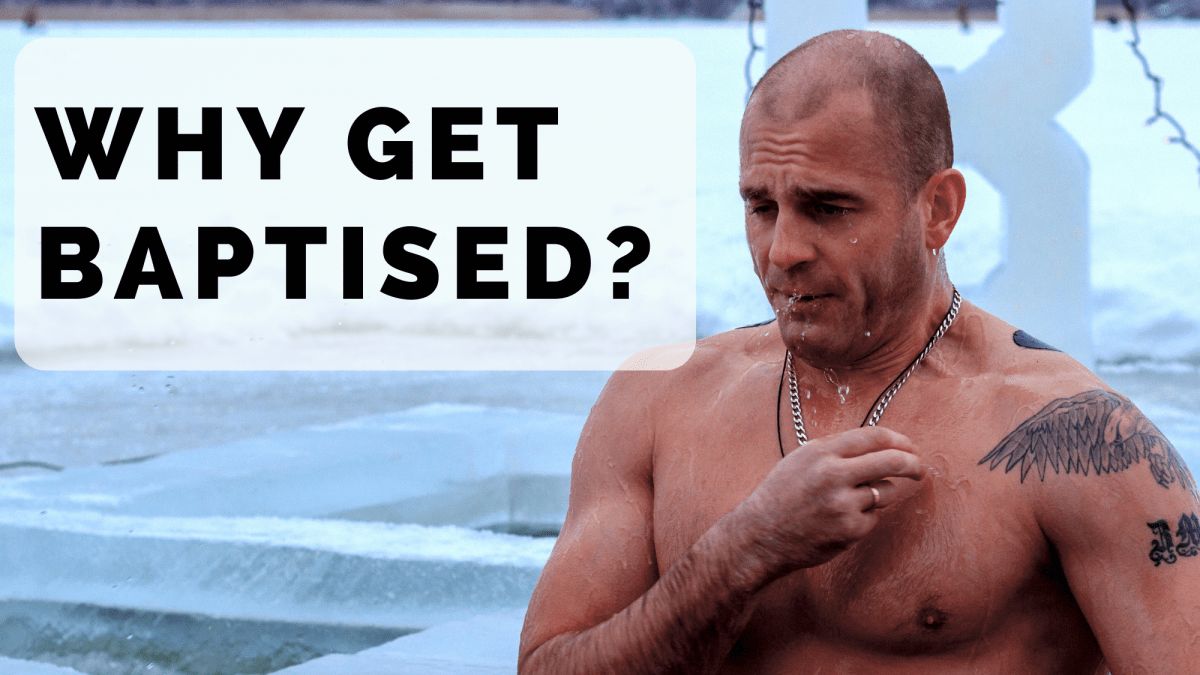
Why Get Baptised?

Why get baptised?
Jesus died because he loves me and gives me new life. Baptism is how I receive that gift.

Then Peter stood up with the Eleven, raised his voice and addressed the crowd: “Fellow Jews and all of you who live in Jerusalem, let me explain this to you; listen carefully to what I say…

“Therefore let all Israel be assured of this: God has made this Jesus, whom you crucified, both Lord and Messiah.”

When the people heard this, they were cut to the heart and said to Peter and the other apostles, “Brothers, what shall we do?”

Peter replied, “Repent and be baptized, every one of you, in the name of Jesus Christ for the forgiveness of your sins. And you will receive the gift of the Holy Spirit. (Acts 2:14, 36-38)

Introduction

The gospel is amazing news. Jesus died because he loves me and offers me new life.

Think about that for a moment.

The Son of God loved us, saw us in our sin, guilt and shame, came to live with us as one of us, took the punishment, the stain, the poison of sin, and then buried it in the ground. He releases us, cleans us, changes us, forgives us, and defeats the Devil for us.

Basically it’s brilliant.

But why do Christians get baptised in response to it?

After all, it is on any view a strange sight. An otherwise sane boy or girl, man or woman stands in a massive bath, fully dressed (thankfully), and then allows a pastor or leader to dunk them under the water. They emerge, drenched, for a room full of Christians who are clapping, cheering and (occasionally) crying.

Ancient Roots

It’s weird, properly weird. But it is also ancient.

It is the earliest recorded teaching of the Christian church that we receive new life by believing that Jesus rose from the dead, acknowledging that we need his love and forgiveness, committing ourselves to follow his teaching and being baptized into his church. Everyone who wants to follow Jesus is commanded by the apostles and their successors to be baptized.

We could give loads of examples from the New Testament. Here are just a few:

  • Jesus got baptized (Matthew 3:13-16; Mark 1:9-11; Luke 3:21-22).
  • Jesus’s followers then baptized new believers while Jesus was alive (John 3:22).
  • Jesus told his followers to go and baptize people all over the world (Matthew 28:19-20).
  • When the first church began at Pentecost, Peter commands new believers to be baptized (Acts 2:38-39).
  • That pattern is replicated over and over throughout the early churches – people hear, they believe in Jesus, they trust him, and they get baptized (Acts 8:34-40, 9:17-19 etc).

These are just a few references that you can look up to see the way baptism is a central part of the start of a Christian journey. That pattern carried on after the New Testament. Everywhere people became Christians, they got baptized.

But Why?

There is an enormous amount that could be written about baptism. At its heart, though, baptism has both a spiritual and practical effect in our lives as Christians.

Spiritual Effects

We believe that baptism is about what God has done and is doing in us through Jesus Christ.

When we are baptized we receive God’s grace and are united to Jesus and to the church.

Two pictures help us understand this: burial and bath-time.

When we go under the water we are identifying with Jesus dying and being buried. That is what St Paul means when he says “we are buried with him through baptism”. Then when we come up out of the water we are identifying with Jesus rising from the dead.

It is as if we are looking at what Jesus has done for us and saying ‘yes, I want to be a part of that’ and in response God says ‘OK, then I’ll make you a part of that’.

This isn’t just a sign or an act; it really changes us in our spirits. When we are baptized, we receive God’s grace and are united to Jesus and to the church. 

This brings me to the second picture: a bath.

I love to play football. When I do I end up covered in dirt and sweat and (sometimes) blood.

I come in from a game and before I can get on with the rest of my life, I need a bath or a shower. I need to soak in the clean water to get all of this grime and grease and stain off me. Then I can start afresh.

Part of the symbolism of baptism is that of a bath, of washing. I don’t mean that we clean our bodies. It’s about a deep cleansing for our souls.

Baptism, as a part of the whole process of identifying with and trusting in Jesus, is how God washes us clean of all the dirt and grime of sin – of the human propensity to mess stuff up, the unkind words, acts of temper, moments of violence and bitterness, the selfishness or snideness, the dishonesty or disrespect – that cling to us through our lives.

Practical Benefits

But there is a practical benefit too.

Following Jesus can be a life of great joy and peace and purpose. It is to live in tune with the moral and spiritual music of the universe, to find community and comfort and peace.

But it can also be really hard. There are times when we mess up, times when others hurt us, times when we are rejected or bereaved, times when we doubt God’s love for us, our faithfulness to him, or even his existence.

When we go through these experiences, God has given us something concrete to cling to.

Whenever you feel like this, you can look back to today and remember the feeling of being wet. You can remember the way the water touched every part of you. That was real, it was tangible. And it is a promise; that God will never leave you or forsake you, that, in the words of St Paul,

neither death nor life, neither angels nor demons, neither the present nor the future, nor any powers, neither height nor depth, nor anything else in all creation, will be able to separate us from the love of God that is in Christ Jesus our Lord.[1]

So What?

What does this actually mean for us?

Some of us may never have actually responded to what Jesus did for ourselves.
Jesus lived, and died and rose again for all of us. But we have to accept it and make it our own. It’s a bit like being given a cheque for a huge amount of money. It doesn’t benefit me unless I cash it.  You might have been in church your whole life or this might be your first time. If you’ve never consciously responded then take a moment to do so even as you read this.

Others might have become followers of Jesus recently or in the distant past. But maybe you haven’t yet been baptised. If that’s you, I want to encourage you to get baptised. It is commanded by Jesus, it is good for you now, and it will help you in the future.

Jesus died because he loves me and offers me new life.Baptism is how I receive that gift.


[1] Romans 8:38-9