I’ve Become a Catholic

Earlier this year, after a lifetime in charismatic Evangelical churches, including 13 years helping to lead a Baptist church, I became a Roman Catholic. 

Earlier this year, after a lifetime in charismatic Evangelical churches, including 13 years helping to lead a Baptist church, I became a Roman Catholic. 

For the last 6 months I have not written or talked about this change publicly both because I wanted to give a chance for my family to adjust to our new lives and because I do not consider myself qualified to be an internet apologist for Catholicism. However, I have just begun a new academic year as a Catholic University Chaplain (you can follow me here and here) and, since posts have begun to appear that look conspicuously Catholic, I thought I had better say something for those who are confused or bewildered.

Catholicism is Great

First, I really like being a Catholic. I don’t want to come across as a triumphalist convert. I am acutely aware of all the foibles, failures and frustrations of the reality as well as the theory of the Catholic Church. But notwithstanding all of that; I love her. Catholic Christianity is saturated with grace, makes coherent sense of Scripture, invites me to participate in the single greatest intellectual and spiritual tradition in the history of humanity, provides me with beauty and wonder, enfolds me in the most diverse organisation in the world, and, most significantly, offers me the substantial body and blood of my Saviour. I go to Mass often; I would go every day if I could.

My wonderful, intuitive and succinct wife pointed out to me a while ago that we used to speak often of being hungry and thirsty for Christ. Now I feed on him each week in the sacrament. When my priest hears my confession and speaks the words of forgiveness and cleansing over me it does not merely communicate a spiritual reality, it brings that reality into existence in my soul. The liturgy in my local parish is not as much fun as a really well constructed and executed worship set. But it brings me the voice of Scripture and prays in return everything that needs to be said in a way that is both concise and beautiful.

Moreover, to become Catholic is to join oneself to the whole communion of the Saints throughout the ages in a way that is real and powerful. My experience of the history of the church and her great heroes as a Protestant was similar to the way I might think of great Spurs players of the past; I can look at them and learn from them but not play with them. Indeed, I am being generous here; as a Protestant I could only really publicly learn from or acknowledge a few – principally Augustine and the Reformers. Aquinas, Bonaventure, Therese of Liseaux and so on were, to say the least, suspect. Were they great heroes for us or suspect? Now I not only learn from the saints, I pray with them and they with and for me. My whole understanding and appreciation of the truth of the resurrection of the dead and the communion of saints has been transformed by the knowledge that those who go before us still stand with us, pray for us and do so powerfully.

Being a Catholic is great.

I Still Love Protestants

I still love Protestants.

Becoming Catholic is obviously a huge decision. It has meant changing job, moving house and has put strain on relationships I had previously thought strong. There are obviously some profound theological differences between the evangelical and Catholic understandings of Christianity. I don’t want to diminish those differences. Some are relatively trivial. Others are more profound. But for all this I do believe that my brothers and sisters in Protestantism are just that: brothers and sisters and I have nothing but love for them. 

My own reception into Catholicism is not, from my perspective at least, a repudiation of the evangelical charismatic world or a denial of God’s work within it. I remain grateful for all God did in me and my family through the work of bodies like New Frontiers and the brothers and sisters we worshipped with and pastored at HBC. I believe the Spirit is really at work in and through them, changing lives, saving souls and healing bodies. The work those churches do is extraordinary and profound as is their love for Scripture and the Spirit. I would not be who I am without them; I love them and continue to pray for them.

This is, no doubt, hard for some to hear. Inevitably there is a sense of loss when someone becomes Catholic, especially if, like me, they have worked and pastored in a Protestant context. For those who hear of my conversion and feel some sense of pain at it, I hope it will be reassuring to know that I became Catholic because I positively believe the Catholic understanding of Christianity to be a true and good fulfilment of everything I experienced in my Protestant faith. It is not, in this sense, a rejection of anyone but rather a continuation of the same pursuit of Christ that characterises evangelical piety. Indeed, a crucial part of my own emotional journey towards Catholicism was reading the works of Joseph Ratzinger and deeply desiring the knowledge of Christ and the joy in his beauty that I discovered there.

So, how did it happen?

Conversion is Both a Process and a Punctuation Point

Coming to the Catholic Church was very like getting engaged. I can tell you the time and place I became engaged to Heather. It was a Sunday evening in late August in my parents’ living room. I know what we ate just before it (lasagne) and how it happened (I wrapped a ring in a series of boxes like Russian dolls before going down on one knee). I asked her to marry me, she promised to do so and we were engaged. In the same way I can tell you the day and the time I became a Catholic. On 20 March 2025 at about 1845 I stood before Fr Con Foley at Christ the Prince of Peace in Weybridge, promised to receive all that the Catholic Church teaches as revealed by God. He laid his hand on my head and prayed for the Spirit to fill me and use me. I was filled with joy and then received my first Eucharist. It was, like our engagement, one of the most important days of my life.

It is important that both our engagement and my reception into the Church were definite moments. Before I asked Heather to marry me, she had made no promise to do so. We were not pledged to one another. Something changed in that moment as we went from one state to another. In the words we exchanged and the physical pledges we offered, our status was altered. Before that service on 20 March I was not a Catholic. I had not promised to obey the Church’s teaching, had not acknowledged it as revealed by God, and could not receive the Eucharist. When people ask me when I became a Catholic, therefore, I tell them that I can name the day and time just as I know the moment I became a fiancée (and later, even more so, a husband).

At the same time, conversion, like engagement, is the culmination of a process that takes time, sometimes years, proceeding on occasions dramatically and at others imperceptibly. My engagement to Heather was the fruit of a year of friendship and love between us. Going back further, it flowed from the work of God in both of our lives shaping our desires for a partner and a life lived for God. Over time it became increasingly clear where that process would likely be leading until Heather was sat at a dining table with a ring on her finger and a crying man at her feet. We were not engaged until that moment, but that moment came because of everything that had gone before.

My coming to the Church was similarly a process that, viewed in retrospect began many years ago. It proceeded through a thousand questions, prayers and experiences that led to it. It came through my wrestling with Scripture, with prayer, with pastoral work and with history. It came through moments of grace and joy, tears and frustrations, through pain and through the providence of God.

I mention this to reassure those who find themselves on a spiritual journey of whose destination they are as yet unsure. I did not believe my journey would lead to the Church until it was nearly over. Christ led me through all my preaching, friendships, prayer and pain to a place I did not anticipate. It was a hard journey. And yet, from this side I can see his grace and love in it.

For me my conversion is a process and a punctuation point. Prior to 20 March I never preached or taught anything that was distinctively Catholic. My theological arguments proceeded using Protestant sources and logic. Nor did I receive communion in a Catholic Church. I was not a Catholic until that time.  And yet from the perspective of my being a Catholic I can see how that evangelical work, the love of Scripture, of the Church, of God’s people and work, led me to find my home in Rome. I hope it will lead me deeper and deeper into God’s love and his Church.

Where To from Here?

If you are still reading this post, I imagine you may be interested in what I am going to do next and what has come of my wonderful wife and her ministry. I am at present working on finishing my PhD examining Baptist doctrines of the Church in conversation with Joseph Ratzinger. While I am doing that, I am the Catholic chaplain at Royal Holloway University and about to begin teaching RS at a local secondary school. I have no idea what God’s plan is for me in the future save that I would love for it to involve bringing as many people to know Jesus, to find love in his Church and to receive his grace as I can.

Heather’s story is her own to tell. For the moment I can say that she, too, has experienced a great joy in becoming Catholic and has found particular peace and fulfilment in the Eucharist and in a deepening relationship with the Saints of the Church. She is currently working in a prison as a chaplain. I have never seen anyone more obviously used by God to bring light into darkness.

If you would like to know more about how this all happened, please feel free to reach out to me privately. We value and covet your prayers above all.
Having Hope in an Age of Darkness

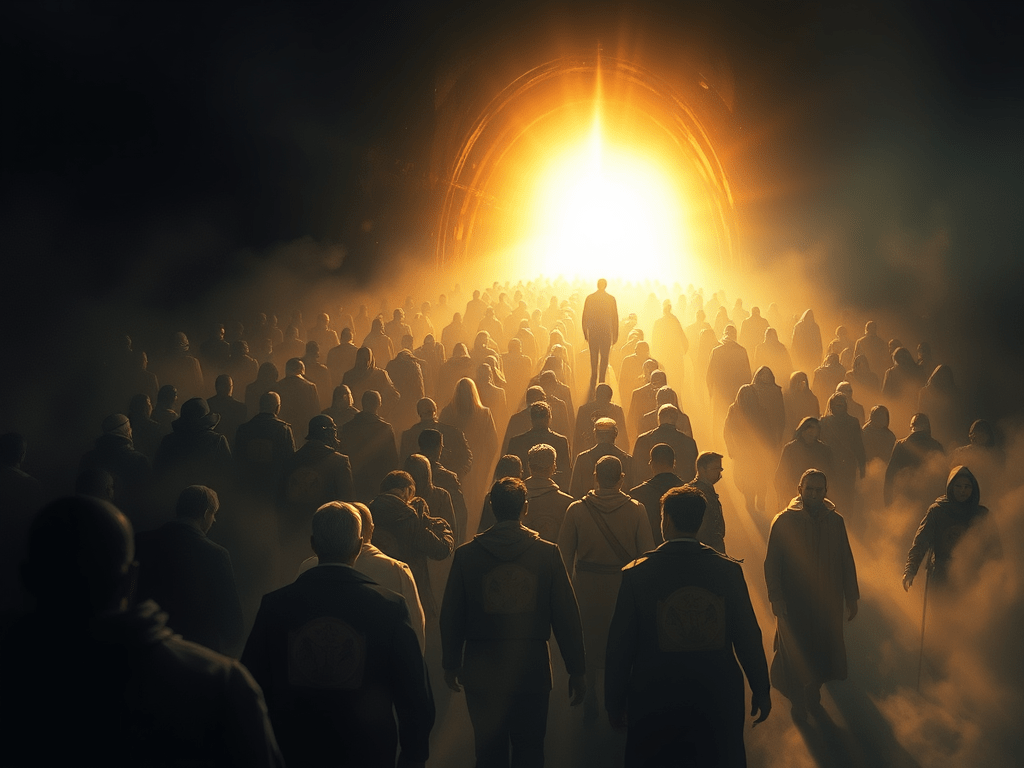
In a season of darkness we can keep on choosing life. We can be committed to embracing new life in babies, to making our homes, families, workplaces, friendships as open to life and grace as we can. We can embrace the stranger, care for our elderly, show love and compassion to our enemies. We can resolve never to give in to nihilism or self-centredness and instead keep living for the sake of God and of others. This will not be easy. But it is possible because God keeps his promises.

Do not be afraid! God keeps his promises.

I wrote these reflections on how to live free from fear and anxiety, how to be a people of hope, before last week’s decision concerning assisted suicide.1 In light of that vote, however, these ideas are particularly important. 

One of the famous texts that is read at 9 Lessons and Carols most years is Jeremiah 33:14-16. It is all about hope and fear.

Jeremiah begins his message to Israel with reassurance about God’s faithfulness:

The days are coming,’ declares the LORD, ‘when I will fulfil the good promise I made to the people of Israel and Judah.

It is worth sitting with this for a moment. God makes promises to us. He is a promise making God.

Incidentally, God doesn’t have to be like this. He could be arbitrary – doing whatever he wants whenever he wants it. That kind of God is a tyrant, untrustworthy and unreliable. We intuitively know God isn’t like this. It is written into the very fabric of the universe which, completely unnecessarily, is governed by laws. In that it reflects the character and mind of its Creator.

One of the earliest things we read God say in Scripture is a promise. We can read about this in Genesis 3:14-15.

Through Eve and then Adam sin had entered the world. She had received a message from an angelic messenger – pictured here as a serpent – who tempted her with a promise of power. If only she defied God, humanity would take God’s place. And so she had taken the fruit and ate. It was an act of defiance, of rejection, and it brought a poison into humanity that would eat up and kill generation after generation. They would be cut off from the presence of God and his light. This is always the path when we choose darkness. Man and woman are promised that they will become like God; instead they become less than human. The rejection of light and life is the embrace of darkness and death.

But at the outset of this creeping darkness God spoke a promise of light. One day there would arise a woman who would have a Son and that Son would crush the serpent. He would provide a Redeemer to deliver humanity from the curse it had brought upon itself. These promises are repeated in different forms throughout the Scriptures to Israel and then to her kings and prophets. King David is promised a son who would reign not as one who dies but who lives forever.

We can read these promises, and receive them for ourselves. Perhaps you feel you have had promises from God – that you would flourish, that your friend or family member would come to know Jesus, that he would never forsake you. But at times it feels as if the promise is failing. We wait and wait but still the darkness advances and we come to fear the future, to fear the power of the Serpent, to fear that God has failed.

That was the position of ancient Israel when Jeremiah spoke. The promise to King David seemed in ruins. The kingdom he built had divided, his sons had failed morally, politically, militarily. And his people were going into exile. On and on the darkness marched as the Serpent’s voice seemed the only one that sounded.

It was precisely at this time that Jeremiah reaffirms the promise. He calls his people to hope.

God speaks in the midst of the darkness and what he says is “Fear Not!” “Do not be afraid”. The God of Israel, of the Cosmos, of your heart, is the God who lives and reigns even when darkness abounds.

The hope of Israel may seem to have fallen and been crushed but God is going to make it spring up, sprout from the broken stump of David’s line. Can you feel the imagery? David’s tree has been axed down, felled and broken. But in this moment of death God is going to bring resurrection. 

And so we come to Luke 1 and the story of the annunciation. The familiarity of the verses can blind our eyes to the reality of what is happening.

Here is the second woman, filled with grace (v.28). Your copy will read “highly favoured”, literally, saturated with God’s gifts. She is one who has been prepared and sanctified by God for this moment. While Eve’s sin had separated humanity from God and now to Mary comes the word: “God is with you”. Eve had brought the Serpent to power; through Mary will come the One to crush that Serpent’s head. And where Eve had defied God’s design for her grasping power and equality with God, Mary would reply “I am the Lord’s servant…May your word to me be fulfilled.” To the woman comes an angelic message. The promise is to be fulfilled. David will have his king to sit on the throne.

Suddenly, when hope seemed lost, when Israel was dominated by tyrants, humiliated and oppressed, when the promises of God were a long-held but distant memory, God acted.  He had been working through all the ages even when we could not see it.

He was working in Cain and Abel, in the flood of Noah, in Abraham and Joseph, in David and Solomon, in Ruth and Moab, in Esther in Exile, through Isaiah and Jeremiah and Micah and the Macabees. It was hard to see, darkness seemed to reign, death seemed ever more present. Fear was a natural response. And yet God was working.

And so he brought a new Eve, ready to bear the fulfilment of every promise – the eternal yes, the final word: Fear Not!

Even as Christ battled demons, diseases and demagogues, darkness and death seemed to triumph. But a voice would echo from the despair of Calvary: Fear Not! And Christ would rise triumphant from the grave.

My friends and fellow-sinners. I don’t know what promises you have received from God this year or through your life. Some of us are in that moment of rejoicing, standing with St Mary and acclaiming with joy: How can this be? What a God who fulfils his promises!

Some of us are in exile with Jeremiah, looking at a life which seems marked with pain where the presence of evil is all too obvious. The temptation is to despair, to succumb to fear of the present of the future.  If that is you, you are in good company. But my message to you this morning is the same as Jeremiah’s: Fear Not! 

The God of Israel, the God of Eve and Mary, the God of Jesus Christ has not forsaken you or forgotten you. It is precisely from the place of death that we encounter resurrection power.

The world can seem increasingly dark. There are wars and rumours of wars. The gospel retreats in the West even as it advances in the East and in Africa. At times it feels as if the Serpent is winning and the kingdom of death and darkness are at hand. But even now, especially now, God is at work. He has not forsaken us. He will not forsake us. Fear Not!

There will be a day when you will stand in glory with Mary and acclaim the glorious faithfulness of her Son. When you will stand with Jeremiah and say: I saw the fulfilment of the promises. When the hand that flung the stars and surrendered to nails will wipe the tears from your eyes and speak over you words of love and grace. Fear Not!

If your life is hard, then take heart. God hasn’t forsaken you. Lean into him. Find a good prayer app or practice that you can hold onto even when life is hard. You can try the Bible in One Year, Lectio 365, or Hallow.

Often the answer to our prayers, the fulfilment of God’s promises in our lives, requires our consent, our courage. Mary is our mother in this: we need to resist the temptation to become hardened or so sad that we are unable to say ‘yes’ when the promises begin to be fulfilled.

Finally, we need the courage to live as men and women of hope and life in the midst of a culture that embraces despair and death.

Our culture is becoming increasingly dark. This is likely to continue. Once one has accepted the logic that unborn life can be terminated for reasons of convenience or, to be blunt, finance, the logic of terminating other inconvenient life becomes irresistible. And so it has proved. This is a deeply dangerous trajectory for a society to be on and it can cause us to feel lost and afraid.

The alternative is to have the courage to keep on choosing Christ, to keep on choosing life. We can be committed to embracing new life in babies, to making our homes, families, workplaces, friendships as open to life and grace as we can. We can embrace the stranger, care for our elderly, show love and compassion to our enemies. We can resolve never to give in to nihilism or self-centredness and instead keep living for the sake of God and of others. This will not be easy. But it is possible because God keeps his promises.

    1. I refuse to use the euphemism ‘assisted dying’: words matter and we should not hide from the reality that what was approved last week is physicians giving poisons to patients so that they can kill themselves ↩︎

    How Can We Understand the Bible?

    For many people, reading the Bible can be hard. This is a quick guide to how we can understand it’s deep meaning and know God better.

    For many people, reading the Bible can be hard. There are bits that seem easy to follow (like when Jesus teaches people), that seem irrelevant (tell me again about eating shellfish in the desert), that are obviously picture language or poetry (the trees in the fields don’t literally clap their hands), and that just seem weird (all of Revelation). 

    Then there is the way Biblical authors use other bits of the Bible. For example, John the Baptist looks at Jesus and describes him as “the lamb of God, that takes away the sins of the world” (John 1:29), St Paul writes about the stories of Israel finding water in a rock only to say “the Rock was Christ” (1 Corinthians 10:4). It is perfectly reasonable to ask: what on earth is going on?

    The church has always believed that the Bible is a book that operates on a number of levels. I recently came across this summary of how this works in the Catechism of the Catholic Church (paragraphs 109-118). It really helped me to categorise the different ways we engage with Scripture. I’ve reproduced it below (with some of my explanation at the end of each section) in case it helps you too.

    First, read what the authors meant:

    109 In Sacred Scripture, God speaks to man in a human way. To interpret Scripture correctly, the reader must be attentive to what the human authors truly wanted to affirm, and to what God wanted to reveal to us by their words.

    110 In order to discover the sacred authors’ intention, the reader must take into account the conditions of their time and culture, the literary genres in use at that time, and the modes of feeling, speaking and narrating then current. “For the fact is that truth is differently presented and expressed in the various types of historical writing, in prophetical and poetical texts, and in other forms of literary expression.”

    This means that we can’t always simply read the text literalistically. Instead we need to work out what the original author meant and how his readers would have understood his words.

    We do this all the time in English. If I said “it’s raining cats-and-dogs outside”, you get an umbrella. You don’t call the RSPCA. You know that in English that is an idiom or metaphor, not literal. And it would be completely inappropriate to treat it like it was.

    Sometimes it’s appropriate to read the Bible like a history book (for example when dealing with the Gospels or biographies). Sometimes it’s obviously not (for example when dealing with the poetry in the Psalms). Sometimes it’s complicated because the Bible uses types of books that we aren’t familiar with (like collections of Proverbs or Paleo-History).

    Things that can help with this are Pastors and good Bible commentaries.

    Second, read Scripture as a whole, assuming that it is coherent and bearing in mind that Jesus is the point of it all:

    112 Be especially attentive “to the content and unity of the whole Scripture”. Different as the books which compose it may be, Scripture is a unity by reason of the unity of God’s plan, of which Christ Jesus is the center and heart, open since his Passover.

    The phrase “heart of Christ” can refer to Sacred Scripture, which makes known his heart, closed before the Passion, as the Scripture was obscure. But the Scripture has been opened since the Passion; since those who from then on have understood it, consider and discern in what way the prophecies must be interpreted.

    This means that as Christians we believe that the Bible has lots of human authors (all writing in their own personalities and using their own styles) but one divine mind behind it. To put it another way, Scripture is loads of books but together they tell one story. And that story is ultimately about Jesus.

    This means when you take two texts that seem hard to reconcile or contradict one another, they can almost certainly be read as complementing each other or as talking about different things. If you find something that troubles you in this way talk to a Pastor (or read a good commentary).

    Third, read with the Church:

    113 2. Read the Scripture within “the living Tradition of the whole Church”. According to a saying of the Fathers, Sacred Scripture is written principally in the Church’s heart rather than in documents and records, for the Church carries in her Tradition the living memorial of God’s Word, and it is the Holy Spirit who gives her the spiritual interpretation of the Scripture (“. . . according to the spiritual meaning which the Spirit grants to the Church”).

    114 3. Be attentive to the analogy of faith. By “analogy of faith” we mean the coherence of the truths of faith among themselves and within the whole plan of Revelation.

    The Bible is a book that is meant to be read in community. Jesus promises that as we live together as the Church, we are guided by his Spirit and learn how to read the Bible correctly (eg John 15:26). This goes for the Church in the world now but also throughout time. We want to hear how the Spirit has directed us to read Scripture, and that means reading it in the community of the Church. It also means that sometimes we have to have the humility to accept that we may have misunderstood something from Scripture and to be corrected.

    Four, pay attention to the different senses of Scripture:

    115 According to an ancient tradition, one can distinguish between two senses of Scripture: the literal and the spiritual, the latter being subdivided into the allegorical, moral and anagogical senses. the profound concordance of the four senses guarantees all its richness to the living reading of Scripture in the Church.

    116 The literal sense is the meaning conveyed by the words of Scripture and discovered by exegesis, following the rules of sound interpretation: “All other senses of Sacred Scripture are based on the literal.”83

    117 The spiritual sense. Thanks to the unity of God’s plan, not only the text of Scripture but also the realities and events about which it speaks can be signs.
    1. the allegorical sense. We can acquire a more profound understanding of events by recognizing their significance in Christ; thus the crossing of the Red Sea is a sign or type of Christ’s victory and also of Christian Baptism.
    2. the moral sense. the events reported in Scripture ought to lead us to act justly. As St. Paul says, they were written “for our instruction”.
    3. the anagogical sense (Greek: anagoge, “leading”). We can view realities and events in terms of their eternal significance, leading us toward our true homeland: thus the Church on earth is a sign of the heavenly Jerusalem.

    118 A medieval couplet summarizes the significance of the four senses:

    The Letter speaks of deeds; Allegory to faith;
    The Moral how to act; Anagogy our destiny.

    This is the hardest bit for us to grasp but it makes sense of how the apostles and other Biblical writers used Scripture and unlocks a lot of what God is wanting to tell us through it.

    Put simply, there are four ways that we can interpret different bits of the Bible. They aren’t contradictory – they are like levels of meaning (kind of like a Russian doll). They are:

    1. The “Letter” or “Literal” sense.
      This doesn’t mean taking everything literally. It means asking what a passage would have meant to the original readers. This is what we talked about above. It means reading bits of the Bible according to the type of book they are (poetry, history etc). It is the basic question: what is the writer trying to say here. For a lot of modern Bible scholars, this is as far as they go (which is a shame and means we miss a lot of meaning that the ancient church understood).
    2. The “allegorical” sense.
      This means way that the bits of the Bible we are reading teach us lessons about Jesus even when he doesn’t explicitly appear. This is what John the Baptist is doing when he describes Jesus as the “Lamb of God” or what St Paul is doing when he describes a Rock from the Old Testament as being about Jesus. It realises that when God inspired the Bible he was always pointing us to Jesus, even when the original authors didn’t realise it. So, for example, the story of the creation of Adam and Eve is designed to teach us about Jesus and the church (see Ephesians 5:31-32). Another word for this is Typology.
    3. The Moral sense.
      This is obvious. Bits of the Bible are designed to teach us how to behave. When it says “don’t steal”, you don’t need to reach for a commentary (particularly if the commentary isn’t yours). Other narratives can also teach moral lessons. So, for example, the story of Cain and Abel can teach valuable moral lessons about the danger of anger, jealousy and the destructive consequences of violence.
    4. The “anagogical” or “mystical” sense.
      Stories we find in Scripture can ultimately teach us something important about our eternal destiny in Jesus. So, for example, the story of God bringing Israel out of slavery in Egypt, through a time of trials and testing in the desert, over a river (literally through something that kills people) and into a promised land is a picture of the way God rescues souls, leads them through life and brings them through death to heaven.

    You don’t need to be an expert at spotting all these levels of meaning in Scripture right away. One of the good things about being part of a Church is that many men and women have spent their lives meditating on Scripture and explaining to us what they saw so that we can see it too. It’s also part of why God gives the church teachers – so that we can grow in understanding him and his word to us.